
RELAY 06: SHIPS
PILLAR I: IDENTIFY
Observational — What happened? What are the key facts?
Era: Age of Exploration
Object: Sail
Archetype: The Navigator
Energy Type: Wind
Active Web: Commerce Web
PILLAR II: UNDERSTAND
Educational — Why did it happen? What can we learn?
Key Inventions & Technologies
| Innovation | Significance |
|---|---|
| Pesse Canoe | Oldest known boat — a dugout canoe found in the Netherlands, carved from a single Scots pine trunk. 3 metres long, designed for inland waterways. |
| The Rudder | Stern-mounted steering device invented in China, replacing the steering oar. Allowed precise directional control without requiring crew strength. |
| Lateen Sail | Triangular sail enabling sailing into the wind at an angle (tacking). Adopted across the Mediterranean and Indian Ocean. |
| Watertight Compartments | Sealed hull sections preventing total flooding if one section was breached. Chinese innovation adopted by the West centuries later. |
| The Dry Dock | Enclosed basin that could be drained for ship construction and repair. Chinese innovation enabling work on hull below the waterline. |
| Magnetic Compass | Magnetic north-finding device. Chinese invention using lodestone, later refined with a magnetised needle floating in water. |
| Zheng He's Treasure Fleet | 317 ships including 'treasure ships' up to 120m long (5x the size of Columbus's Santa Maria). 27,000 crew. Seven voyages reaching East Africa, Arabia, and Southeast Asia. |
| Carvel Construction | Flush-planked hull design replacing clinker (overlapping) construction. Planks laid edge-to-edge over a pre-built frame. |
Biomimicry & Natural Blueprints
Fish and Marine Mammal Hydrodynamics
→ Streamlined shapes of fish, dolphins, whales inspired ship hull designs.
Principle: Fluid Dynamics, Biomechanics
Seabird Navigation
→ Navigational abilities using celestial cues, magnetic fields, olfactory senses.
Principle: Navigation Systems, Sensor Technology
Coral Reef Structures
→ Resilience and self-repairing nature for robust maritime structures.
Principle: Structural Engineering, Materials Science
Kelp Forests and Mangrove Roots
→ Natural coastal defenses dissipating wave energy for sustainable coastal engineering.
Principle: Coastal Engineering, Ecological Design
PILLAR III: MANAGE & CONTROL
Application — How do we apply this knowledge?
The Sun Tzu Lens
Sun Tzu
PILLAR IV: THESIS & VISION
What does this mean for the future?
Personal Vignette
Sailing across the English Channel, feeling the power of wind and wave — understanding why mastery of the sea meant mastery of the world.
The Handoff
From the ship, humanity learned to cross oceans and connect continents. But the wind was unreliable — to move faster and carry more, humanity needed a new source of power.
LA MENARA — THE REMARKABLE SHIP
Cultural Significance Across the Five Webs — REF-SHIPS-001
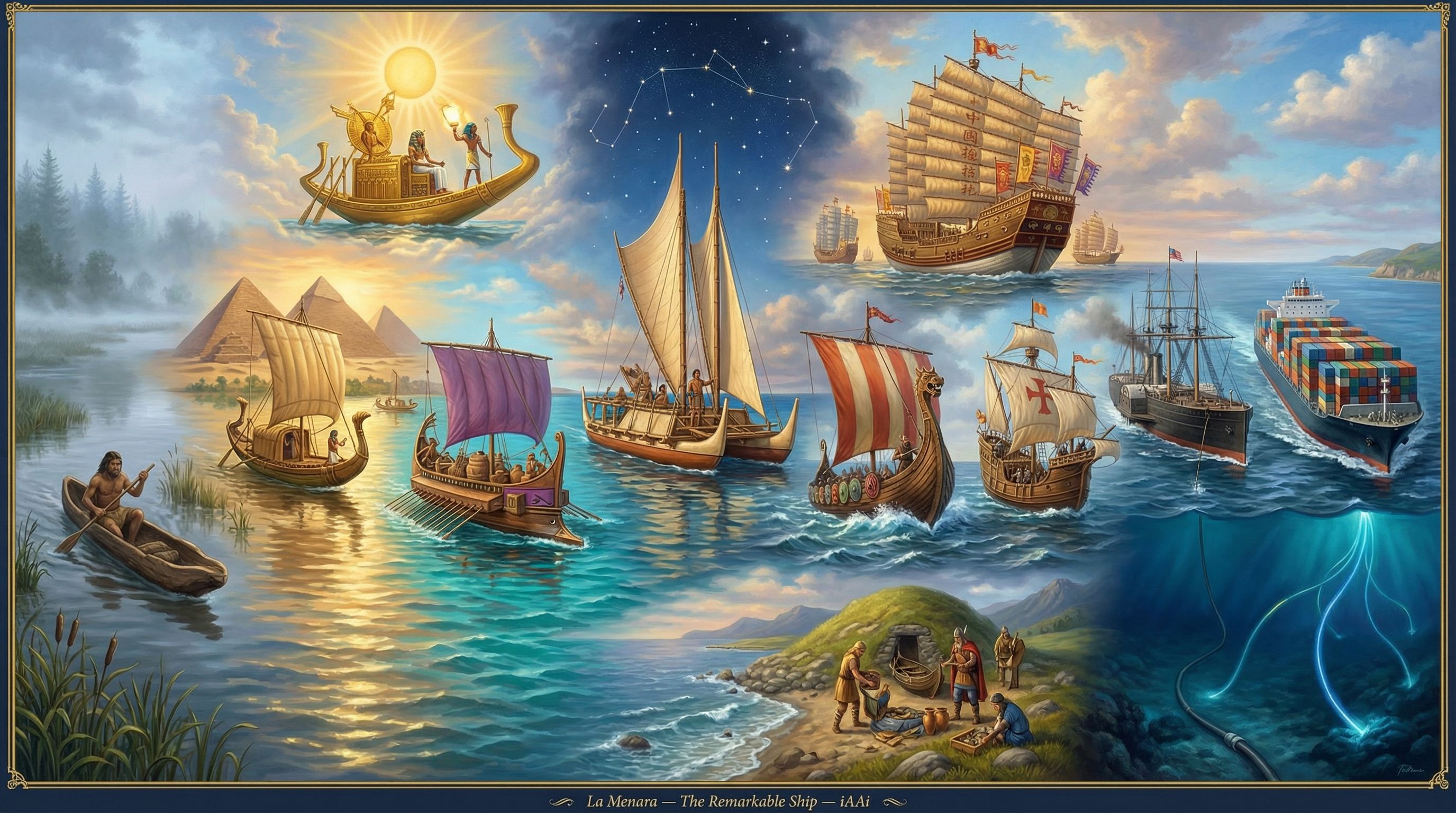
La Menara — The Remarkable Ship: 10,000 years of maritime infrastructure