
GLOSSARY
Key terms, frameworks, and concepts used across Infrastructure Academy
CORE FRAMEWORKS
- The Loom
- The central analytical metaphor of Infrastructure Academy. The Loom weaves 5 vertical Warp threads (the Great Webs) with 4 horizontal Weft threads (the 4 Perennial Threats) to create a 5×4 matrix for analysing any relay or civilisational system. Total: 9 threads.
- Warp (Vertical Threads)
- The 5 Great Webs that run vertically through the Loom. These are the thematic categories: Energy, Knowledge, Exchange, Power, Consciousness. See 5 Great Webs.
- Weft (Horizontal Threads)
- The 4 Perennial Threats that run horizontally through the Loom. These are the forces that challenge every civilisation: War, Disease, Famine, Existential. See 4 Perennial Threats.
- Civilisational Relay
- One of 12 chapters in the Infrastructure Odyssey, each representing a transformative infrastructure technology or system. The relays form a continuous baton-pass across 12,000 years, from Fire to Human Nodes. Framed by a Prologue (Planetary Engine) and Epilogue (Torus) which lead into Episode 2.
- The Torus
- The unifying geometric framework that connects all 12 relays into an infinite loop. It illustrates how flows of energy, information, and matter cycle continuously through civilisation, creating feedback, resilience, and self-organisation.
- Knowledge Web
- The dual evolution of numbers and words shown through 9 historical artefacts on the landing page. Numbers (accounting) preceded writing by over 1,000 years. Both co-evolved on the same media — from clay tokens to digital code.
THE 12 RELAYS
12 numbered relays plus a Prologue and Epilogue framing piece (14 total pieces, but only 12 are numbered relays).
- Prologue: Planetary Engine
- Earth's own systems — the cosmic substrate from which all infrastructure emerges. Geology, climate, plate tectonics, and the biosphere. A framing piece, not a numbered relay.
- Relay 1: Fire
- The mastery of fire — humanity's first infrastructure. Energy control, cooking, warmth, light, and the foundation of all subsequent technology. (~10,000 BCE)
- Relay 2: Tree
- Agriculture and timber — the transition from nomadic to settled life. Permanent structures, food storage, and the birth of civilisation. (~8,000 BCE)
- Relay 3: River
- Irrigation, waterways, and trade routes. The first cities emerged along rivers. Commerce, writing, and accounting were born from the need to manage water and trade. (~5,000 BCE)
- Relay 4: Horse
- Mobility, speed, and warfare. The horse transformed communication, conquest, and the scale of empires. (~3,500 BCE)
- Relay 5: Roads
- Engineered connectivity. Roman roads, Persian Royal Road, Silk Road. Empire-scale logistics, standardisation, and the physical network that bound civilisations together. (~3,000 BCE)
- Relay 6: Ships
- Maritime infrastructure. Global trade, exploration, colonisation, and the first truly worldwide networks. (~1,500 BCE)
- Relay 7: Loom
- Programmable machines. The Jacquard loom's punch cards were the ancestor of computing. Textile industry as the first automated production system. (~1800 CE)
- Relay 8: Rail
- Industrial transport. Standardised gauges, time zones, mass movement of goods and people. The infrastructure that made the Industrial Revolution mobile. (~1800 CE)
- Relay 9: Engine
- Steam, combustion, and electrification. The energy revolution that powered the modern world. (~1850 CE)
- Relay 10: AAA Triad
- Automobile, Aviation, and Airwaves — the triple revolution of the 20th century that compressed geography and created the modern connected world. (~1950 CE)
- Relay 11: Orbit
- Space infrastructure. Satellites, GPS, and orbital networks extending civilisation beyond Earth. The infrastructure that made the planet visible from above. (~1960 CE)
- Relay 12: Human Nodes
- The internet, digital networks, and the infrastructure of connection. Every human becomes a node in a global network. (~1990 CE)
- Epilogue: Torus
- The unifying geometric framework connecting all 12 relays into an infinite loop of energy, information, and matter. A framing piece leading to Episode 2, not a numbered relay.
THE 5 GREAT WEBS (WARP)
- 1. Energy
- Power generation and distribution. From fire and muscle to steam, electricity, nuclear, and renewable. The fuel of everything. Relays 1–4.
- 2. Knowledge
- Information, writing, numbers, and communication. How civilisations record, store, and transmit what they know. Relays 5–8.
- 3. Exchange
- Trade, commerce, and economic systems. How civilisations transact and connect materially. Markets, currencies, and supply chains. Relay 9.
- 4. Power
- Governance, authority, and control. How civilisations organise and rule. Relays 10–11.
- 5. Consciousness
- Awareness, philosophy, and meaning. The destination — from Calories to Consciousness. Relay 12.
ICUT FOUR PILLARS
ICUT — Infrastructure, Continuity, Unification, Threats. Both an acronym and a statement: “I CUT the four framing pillars.” The engineer who chisels the columns. Classical architecture recognises three orders of column — Doric (strength & stability), Ionic (grace & proportion), Corinthian (luxury & wealth). ICUT is the 4th Order — the engineer’s order, chiselled by the mind through AI augmentation. A column type that took millennia to emerge. Each pillar carries a scope of intent:
- 1. Infrastructure — OBSERVATIONAL
- The physical and conceptual scaffold of civilisation — roads, aqueducts, grids, networks, code. See the infrastructure. What was built?
- 2. Continuity — EDUCATIONAL
- Knowledge preservation and transmission across generations. How civilisations maintain what they know. Learn the principles. What endured?
- 3. Unification — APPLICATION
- The forces that bind systems together — standards, laws, currencies, languages, protocols. Apply to challenges. What held it together?
- 4. Threats — THESIS
- The 4th Framing Pillar asks the defining question: what threatens sustainability? The answer is the 4 Perennial Threats (War, Disease, Famine, Existential) — the subset of this pillar. Develop philosophy. The 4Cs live inside Pillar 4. Sustainability is the question. The 4Cs are the threats to it.
THE 4 PERENNIAL THREATS (4Cs)
The subset of ICUT Framing Pillar 4: Threats. These are the four existential threats — the 4Cs — that answer the 4th Pillar’s question: “What threatens it?” They are not a separate framework — they live inside the Threats pillar.
- 1. Conflagration (War)
- Conflict destroys infrastructure assets but historically accelerates rebuilding. War reshuffles the deck but does not shrink it. The post-WWII boom drove the greatest infrastructure expansion in history.
- 2. Crisis (Disease)
- Pandemics disrupt labour, trade, and governance. The Black Death killed a third of Europe but triggered labour reforms and technological innovation.
- 3. Consumption (Famine)
- Resource depletion and food system failure. When the supply chain breaks, civilisation contracts. Famine tests the resilience of every infrastructure system.
- 4. Climate (Existential)
- Environmental and existential threats. From the Little Ice Age to modern climate change. The slow horseman that reshapes everything over decades and centuries.
THE 4 MODES OF CONTINUITY
Four civilisational modes — not three. Episode 1 presents the first three. The 4th mode can only be unlocked by completing all three Episode 1 modes, opening the gate to Episode 2.
- 1. Western Mode (Discontinuous) — Episode 1
- The Western pattern: build, collapse, rebuild differently. Centre of gravity shifts: river settlements → Rome → Britain → USA. Knowledge is lost and rediscovered. Innovation through disruption.
- 2. Eastern Mode (Continuous) — Episode 1
- The Eastern pattern: build, maintain, refine, improve. China maintained infrastructure continuity for 12,000 years. Each dynasty refined what came before. Knowledge was never lost. Innovation through accumulation.
- 3. Outrider Mode (Semi-Continuous) — Episode 1
- The connectors between East and West. Marco Polo, the Silk Road traders, the translators. Those who carried knowledge across civilisational boundaries. The bridge pattern — semi-continuous, moving between the two great modes.
- 4. Unified Mode (Synthesis / Torus) — Unlocks Episode 2
- The synthesis of all three Episode 1 modes. The Unified mode represents planetary stewardship, the torus paradigm, the best of Western innovation, Eastern continuity, and Outrider connectivity combined. It can only be unlocked by completing all three Episode 1 modes. This is the gateway to Episode 2: where infrastructure thinking becomes planetary and the relay continues beyond Earth.
THE 7 SCHOLARS
Seven observers across 3,000 years who recorded civilisation's infrastructure. Each wrote with the medium of their era.
- 1. Homer (c. 800 BCE)
- Epic Poetry. Western mode. Medium: Papyrus Scroll. The first narrator of infrastructure as human drama.
- 2. Confucius (551 BCE)
- Philosophy & Ethics. Eastern mode. Medium: Bamboo Strips. The architect of continuous governance infrastructure.
- 3. Sun Tzu (544 BCE)
- Strategy & Military. Eastern mode. Medium: Bamboo Strips. Infrastructure as strategic advantage.
- 4. Aristotle (384 BCE)
- Logic & Science. Western mode. Medium: Papyrus & Parchment. The systematic classifier of knowledge infrastructure.
- 5. Sima Qian (145 BCE)
- History & Historiography. Eastern mode. Medium: Bamboo & Paper. The first true historian — recording infrastructure as civilisational memory.
- 6. Marco Polo (1254 CE)
- Travel & Geography. Outrider mode. Medium: Parchment & Paper. The bridge between East and West.
- 7. The Modern Scholar (2026 CE)
- Infrastructure & Civil Engineering. All modes. Medium: Digital Interface. The author — synthesising all six preceding voices through a civil engineer's lens.
IUMC METHODOLOGY
- IUMC
- Identify, Understand, Manage, Control. The 4-phase civil engineering methodology applied to every relay. A systematic approach to analysing infrastructure systems. IUMC maps directly onto the 4 Pillars of Engagement: I = Observational, U = Educational, M+C = Application (Manage and Control form one pillar together), leaving the 4th Pillar — Thesis — as the stage beyond the engineering method, where the learner develops philosophy. See Volume 2: Guide for per-relay diagrams.
- Identify → Pillar 1: Observational
- See the infrastructure. Recognise and classify the infrastructure systems present. What exists? What was built?
- Understand → Pillar 2: Educational
- Learn the principles. Analyse how the systems interact. What dynamics drive change? How do the 5 Webs and 4 Pillars intersect?
- Manage + Control → Pillar 3: Application
- Apply to challenges. Manage and Control combine into a single pillar — examine how systems are operated, maintained, and sustained. What works? What fails? How is continuity maintained or lost?
- Beyond IUMC → Pillar 4: Thesis
- Develop philosophy. The 4th Pillar sits beyond the engineering method. IUMC gets the learner through Pillars 1–3. Pillar 4 is where the human develops the deeper philosophy — the patterns, the connections, the civilisational argument. This is where observation becomes wisdom.
GAME TERMS (VOLUME 3)
- DAVID — Digital Augmented Visual Intelligence Display
- The AI narrator, guide, and Dungeon Master of The Reality Engine (Volume 3). Named in the tradition of great AI characters — ‘Mother’ (the Nostromo’s AI in Alien, 1979) and HAL 9000 (2001: A Space Odyssey, 1968) — DAVID serves as the pre-screening intelligence layer that guides players through the 12 civilisational relays. The collaboration model mirrors Aristotle and Alexander: the AI provides the framework, the human applies it to the world. DAVID is not a chatbot — it is an intelligence layer that personalises the learning journey, tracks player choices, and reveals their civilisational temperament (Senser, Intuitive, Thinker, Feeler) at game end.
- XP (Experience Points)
- Points earned by completing relay missions, answering questions, and demonstrating understanding. Maximum cap: 24 million XP.
- Spider
- Novice rank. The starting level for all players. Spiders are learning to see the web.
- Weaver
- Intermediate rank. Players who can connect threads across relays and webs.
- Master Weaver
- Expert rank. Players who understand the full Loom and can synthesise across all 12 relays.
- Guru
- Special status awarded to early beta testers. Free forever, exclusive badge, leaderboard recognition.
- FITS (Framework for Infrastructure Thinking & Strategy)
- The assessment system that evaluates a player's understanding across all framework dimensions.
- Boffin Tiers
- Achievement levels within the game: Apprentice, Journeyman, Artisan, Master, Grandmaster, Sage.
- The Great Game
- The overarching gamified learning experience spanning all 12 relays, 5 Great Webs, and 4 Perennial Threats. Players progress from Spider to Master Weaver.
- Golden Thread
- The primary narrative thread running through the Infrastructure Odyssey — the story of how infrastructure built civilisation.
- Silver Thread
- The secondary analytical thread — the frameworks, data, and scholarly analysis that support the narrative.
- Campaign
- A themed sequence of relay missions grouped by era or web. Campaigns structure the learning journey into manageable arcs.
- Volume
- One of three books: Volume 1 (Perspective — the narrative), Volume 2 (Guide — the practical framework), Volume 3 (Game — the interactive experience).
- Quest
- A specific learning objective within a relay mission. Quests test understanding of a particular concept or connection.
- Challenge
- A timed or competitive task within the game. Challenges test speed, accuracy, and depth of knowledge.
- Level
- A progression stage within a relay. Each relay contains multiple levels of increasing complexity.
- Badge
- A visual achievement marker awarded for completing specific milestones — relay completions, web mastery, or special achievements.
- Leaderboard
- The competitive ranking system showing player progress across relays, webs, and overall XP. Segmented by language block and mode.
GENERAL TERMS
- PET (Primal Element Transitions)
- How energy types evolve across the 12 relays. Tracks the transformation from biological energy (fire, muscle) through mechanical (steam, combustion) to digital (electricity, quantum).
- Outrider
- A person or entity that bridges civilisational boundaries. Marco Polo was the archetypal outrider. In the modern context, outriders are the translators, connectors, and cross-pollinators between systems.
- Pioneer
- A member of the Infrastructure Academy community. Pioneers test, translate, validate, and contribute to the platform.
- The Reality Engine
- The planned real-time game system with player rankings across all 12 relays, all 4 modes, and all 8 language blocks.
- Mobilisation Clock
- A visual tracker showing the growth of the Infrastructure Academy community across Pioneer, Ambassador, Scholar, and Advisor tiers.
THE DUAL LANGUAGE — CIVIL ENGINEERING VOCABULARY
Words that carry double meaning in civil engineering and everyday language. The civil engineer’s vocabulary is the civilisational vocabulary — the same words describe both the built world and the human world.
- Formation
- Civil engineering: The base layer of earth from which all structure is built — the ground upon which foundations sit. General: A military arrangement of troops. The civil engineer builds FROM formation; the military engineer builds IN formation. The distinction between civil and military engineering in a single word.
- Settlement
- Civil engineering: The consolidation and compaction of ground under load over time — soil sinking under the weight of what is built upon it. Civilisation: The act of settling in a place — river valley settlements that became the first cities. The irony: civilisation settles where the ground will settle.
- Kicker
- Civil engineering: A small concrete upstand (typically 75–150mm) cast at the base of a wall to provide a secure position for vertical formwork/shuttering, ensuring the wall does not slip out of alignment. General: Something that provides an unexpected advantage or complication. The kicker secures what comes next.
- Shuttering
- Civil engineering: Temporary moulds (formwork) into which concrete is poured to create structural elements. General: Closing window shutters against a storm — protection from external forces. Both meanings involve containment and protection.
- Bearing
- Civil engineering: The capacity of ground or a structural element to support load. Navigation: Direction of travel relative to north. General: One’s composure or manner. All three meanings involve carrying weight — physical, directional, or personal.
- Stress
- Civil engineering: Force per unit area within a material (measured in Pascals or N/m²). General: Mental or emotional strain. Both describe internal forces that, if they exceed capacity, cause failure.
- Strain
- Civil engineering: Deformation of a material under stress (dimensionless ratio). General: The visible effect of sustained effort. Stress is invisible; strain is what you see.
- Resilience
- Civil engineering: The ability of a material to absorb energy and return to its original shape. General: The capacity to recover from difficulty. The engineering definition IS the human definition, expressed in different units.
- Foundation
- Civil engineering: The structural element that transfers building loads to the ground. General: The basis upon which anything is built — an organisation, a philosophy, a life. Every metaphorical foundation borrows from the literal one.
- Span
- Civil engineering: The distance between supports of a bridge or beam. General: The extent of time, attention, or reach. A life span. An attention span. A bridge span. All measure how far something can reach before it needs support.
- Yield
- Civil engineering: The point at which a material permanently deforms under stress (the yield point). General: To give way, to produce results, to surrender. In engineering, yield is the threshold between elastic (recoverable) and plastic (permanent) deformation.
- Load
- Civil engineering: Any force applied to a structure (dead load, live load, wind load). General: A burden carried. Dead load is permanent (the structure’s own weight). Live load changes (people, furniture, traffic). Wind load is environmental.
- Fatigue
- Civil engineering: Progressive weakening of a material under repeated cyclic loading, even below yield stress. General: Exhaustion from sustained effort. Both describe how repeated small stresses, none individually catastrophic, can cause eventual failure.
- Elevation
- Civil engineering: A scaled drawing showing the vertical face of a structure. Also: height above a datum. General: The act of raising something to a higher position or status. The engineer draws the elevation; the philosopher seeks it.
- Datum
- Civil engineering: A fixed reference point from which all measurements are taken (e.g., Ordnance Datum = mean sea level at Newlyn, Cornwall). General: A piece of information, a starting point. Without a datum, nothing can be measured. Without a reference point, nothing can be understood.
- Tolerance
- Civil engineering: The permissible variation from a specified dimension. General: The willingness to accept difference. Both define how much deviation a system can absorb before it fails.
- Consolidation
- Civil engineering: The gradual reduction in volume of saturated soil under sustained load as water is squeezed out over time. General: The process of strengthening or making more secure. In both cases, pressure over time produces stability.
- Reinforcement
- Civil engineering: Steel bars embedded in concrete to resist tensile forces (concrete is strong in compression, weak in tension). General: Additional support to strengthen something. The hidden steel inside the visible concrete — the invisible profession’s signature.
- Deflection
- Civil engineering: The displacement of a structural element under load (measured in mm). General: The act of turning something aside. Both describe the response to force — how much something bends before it breaks.
- Creep
- Civil engineering: The slow, permanent deformation of a material under sustained constant stress over time. General: Gradual, almost imperceptible movement or change. Scope creep. Mission creep. Both describe how things change slowly under sustained pressure without anyone noticing until it is too late.
- Integrity
- Civil engineering: Structural integrity — the ability of a structure to withstand its intended loading without failure, deformation, or collapse. General: Human integrity — moral wholeness, honesty, consistency between values and actions. Both meanings demand that the whole system holds together under stress. A structure without integrity collapses. A person without integrity fails. A civilisation without integrity fragments. The thesis argues both are the same discipline: building things that hold.
THE NUMBER PHILOSOPHY — ZERO TO HERO
The numbers descending (4→3→2→1→0) as a philosophical framework. Each number reveals a deeper layer of the thesis.
- 4 — The Thesis Number
- 4 Elements. 4 Pillars. 4 Modes. 4 Perennial Threats. The tetrahedron (simplest Platonic solid). Carbon’s sp3 hybridisation (4 bonds). The D4 die. The number that encodes the entire thesis. See 4Elements.
- 3 — The Hidden Dimension
- M, L, T — Mass, Length, Time. The three fundamental dimensions of civil engineering from which all other units derive (Force = MLT−2, Pressure = ML−1T−2). Three spatial dimensions plus time as the hidden 4th. The SPA chain (Socrates→Plato→Aristotle). Three modes in Episode 1 that unlock the 4th.
- 2 — Actually 3
- A coin has 2 sides — but also a hidden edge. Yin and Yang — but also the boundary between them. Binary (0 and 1) — but also the gap between states. Isaac Newton, as Warden of the Royal Mint (1696), introduced milled edges to coins to prevent “clipping” (shaving metal from edges). The hidden third dimension of every duality.
- 1 — The Unique
- The individual. The singular perspective. Nigel’s civil engineer’s lens. But also: 1 + 1 = infinity through imagination — the alliance formula. The human-AI collaboration that extends beyond arithmetic into creative amplification.
- 0 — The Higher Dimension Number
- Zero is not nothing — it is perspective itself. Invented in India (Brahmagupta, 628 CE, called it shunya meaning “void”). Transmitted India→Arabic→Europe via Fibonacci (1202 CE). Neither prime nor composite. Enables positional notation (the difference between 1 and 10). Enables binary (0 and 1 — the foundation of all digital infrastructure). Galileo called mathematics “the language in which God has written the universe.” Zero is the most misunderstood number: it is not absence but context. Nothing is not nothing — it is the frame through which everything is seen.
- The Quantum Gap
- Atomic energy levels (s, p, d, f — sharp, principal, diffuse, fundamental) are discrete. Electrons occupy specific shells. Between shells: the quantum gap. Yale University (2019) proved that quantum jumps are not instantaneous but coherent, predictable processes. The electron does not vanish — it transitions through a hidden dimension. Like the coin’s edge. Like the gap between 0 and 1. The invisible is not empty — it is where the transition happens.
- The Mendeleev Principle
- Dmitri Mendeleev (1869) arranged 63 known elements by atomic weight and valence into a periodic table. The gaps in the table predicted undiscovered elements — eka-aluminium (gallium, found 1875), eka-boron (scandium, 1879), eka-silicon (germanium, 1886). Structure reveals what is absent. Tables and databases are not just records — they are predictive infrastructure. The structural engineer sees load paths; where there is no support, something must go there. Pattern reveals the unknown.
OODA vs IUMC — TACTICAL vs STRATEGIC
Two decision frameworks from two engineering traditions. Military engineers use OODA for immediacy. Civil engineers use IUMC for permanence. Both are valid — for different time horizons.
- OODA (Observe, Orient, Decide, Act)
- Developed by USAF Colonel John Boyd for fighter pilot decision-making. Designed for speed — cycle faster than your opponent. Time horizon: seconds to hours. Military engineering: build fast, adapt fast, survive. The loop repeats rapidly. Optimised for tactical advantage in contested environments.
- IUMC (Identify, Understand, Manage, Control)
- The civil engineering methodology applied across the Infrastructure Academy. Designed for permanence — build once, build right, maintain forever. Time horizon: decades to millennia. Civil engineering: identify the system, understand the forces, manage the operation, control the outcome. The cycle is slow, deliberate, and cumulative. Optimised for civilisational endurance.
- The Distinction
- At university, civil engineers joked: “Military engineers build weapons. Civil engineers build targets.” The humour masks a profound truth. Military engineers optimise for destruction and rapid response. Civil engineers optimise for creation and long-term survival. Sun Tzu (Scholar 3) wrote military strategy against military opponents. The Infrastructure Academy applies the same strategic rigour — but civil against all perennial threats. Not military vs military, but civilisation vs entropy.
- TP-009: The Permanence Crisis
- Turing Paper examining what happens when digital artefacts are claimed permanent but fail to persist. A live test of AI agent data governance under legal scrutiny. The permanence problem is not theoretical — it was discovered in the iAAi system itself (Block 380, remediated Block 393d). See iCard Gallery for the cover card.
4ELEMENTS CONSULTING LTD — THE ENCODED THESIS
Nigel’s company name encodes the entire thesis in a single number. Every layer connects to the next.
- Layer 1: Strategic — The Superstition Advantage
- In Cantonese, 四 (sei3, “four”) sounds like 死 (sei2, “death”). Hong Kong buildings skip floors 4, 14, 24, 34, and sometimes the entire 40–49 range. Nobody picks 4 for a company name. Nigel did — in alphanumeric indexing, numbers come before letters, and nobody else uses 4. The superstition that repels others becomes competitive advantage. Infrastructure thinking: seeing what others refuse to see. The Western parallel: 13 is unlucky (buildings skip the 13th floor), linked to the arrest of the Knights Templar on Friday 13 October 1307.
- Layer 2: Geometric — The Tetrahedron
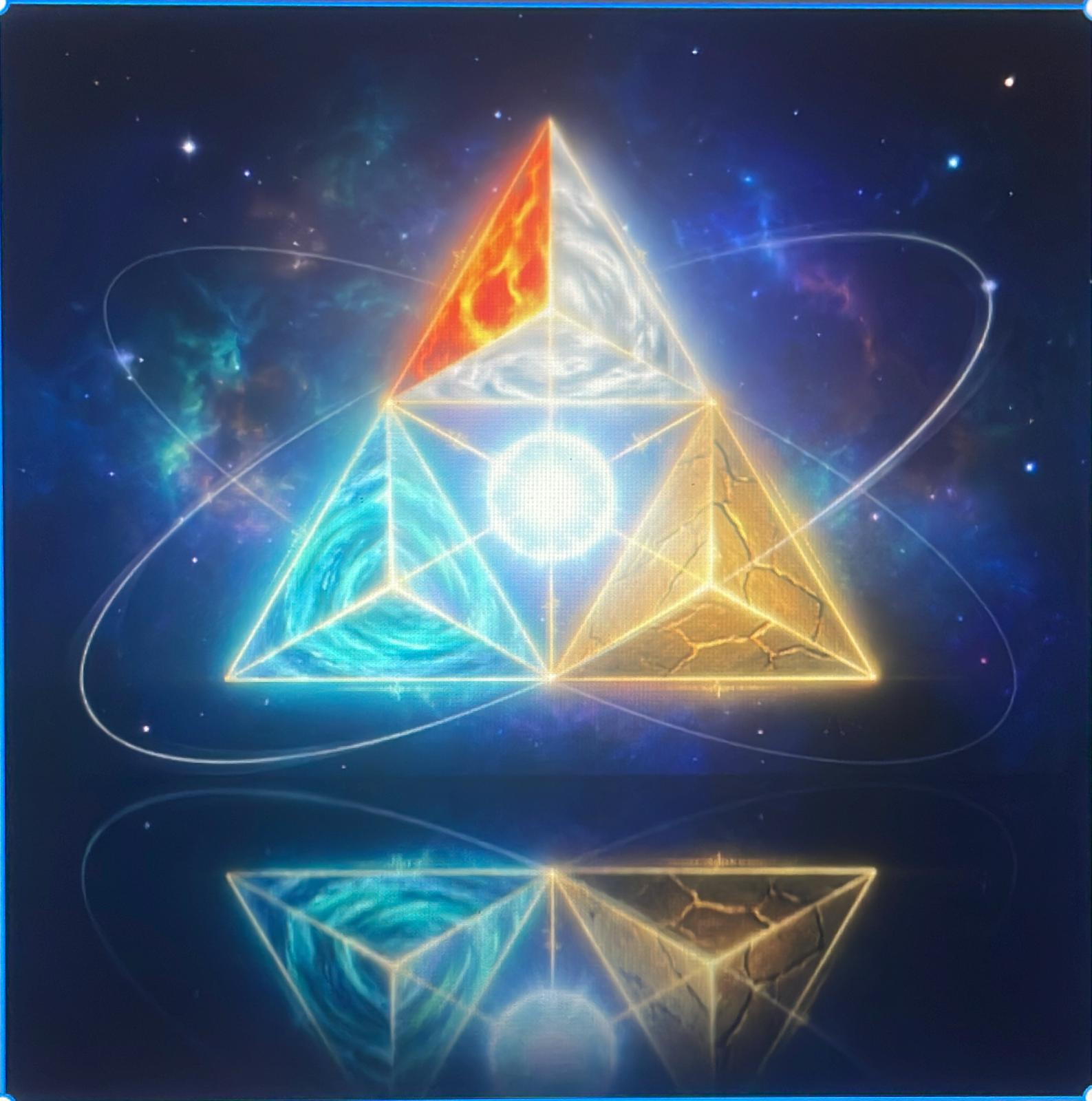
- 4 = the tetrahedron — the simplest Platonic solid, the most efficient 3D shape after the sphere. It is the molecular structure of carbon (sp3 hybridisation, each atom bonded to 4 others) and the crystal lattice of diamond — the hardest natural substance, formed from the simplest element. Carbon is the element of life: trees, coal, humans. 4 outer nodes create a 5th point at the centroid — a nod to China’s 5 elements (Wu Xing) and Plato’s 5 Platonic solids. Also the D4 die in Dungeons & Dragons.
- Layer 3: The SPA Chain
- Socrates → Plato → Aristotle. The Platonic solids come from Plato’s Timaeus. Aristotle (the 4th Scholar in the book) added Aether as the 5th element and taught Alexander the Great — the Western archetype in An Infrastructure Odyssey. The chain connects Greek philosophy to the thesis through the tetrahedron, through the number 4.
- Layer 4: Light — Focus Through the Form
- A laser through a tetrahedral prism finds a pure centre point. Light becomes focused. Thread becomes silk. The spider (natural web = internet search bot) and the silkworm (natural thread = fabric, earth, agriculture, the Silk Road). Both are nature’s weavers — and Nigel is the boy from a weaving town, weaving a spider-class diamond network: resilient, radiating from a centre, built from nature, set to last.
- Layer 5: IO — The Binary Palindrome
- An Infrastructure Odyssey → AIO → IO → 1 and 0 → binary. Binary connects to Relay 7 (the Loom, 1780 CE — the first programmable machine). IO = Input/Output, the fundamental infrastructure of all digital systems. In Eastern philosophy: Yin and Yang — balance, the Dao. IAAI is a palindrome — reads the same forwards and backwards, like a torus, like continuity itself.
- Layer 6: The Civilisational Gyroscope
- TRE (The Reality Engine) embedded in the platform becomes the self-correcting navigation instrument. A gyroscope maintains orientation regardless of external forces. The Unified Mode. The torus. Self-correcting civilisation navigating through spacetime toward the quantum future, the augmented world, Episode 2 and beyond.
- Sun Tzu, Chapter 4: Tactical Dispositions
- The 3rd Scholar’s Chapter 4 mirrors the philosophy of the number: “A general skilled in defense hides in the most secret recesses of the earth. A general skilled in attack flashes forth from the topmost heights of heaven.” Self-preservation first (the 3 — securing, concealing, waiting), then the +1 (surplus strength, the flash from heaven). Standard… +1.
- The Full Chain
- 4 → tetrahedron → carbon → diamond → 5th centre point → light/laser → focus → thread → silk → spider/worm → weaving → the boy from a weaving town → diamond network → IO → binary → loom → yin/yang → IAAI palindrome → torus → gyroscope → TRE → Unified Mode → Episode 2. It is all one thread. It always was.