


RELAY 05: ROADS
PILLAR I: IDENTIFY
Observational — What happened? What are the key facts?
Era: Roman Engineering
Object: Stone
Archetype: The Surveyor
Energy Type: Connective
Active Web: Commerce Web
PILLAR II: UNDERSTAND
Educational — Why did it happen? What can we learn?
Key Inventions & Technologies
| Innovation | Significance |
|---|---|
| The Sweet Track | Wooden causeway built across swamps in Somerset — one of the oldest engineered roads. |
| Persian Royal Road | 1,600-mile highway from Susa to Sardis with 111 relay stations (caravanserais) every 15-18 miles. Mounted couriers completed the journey in 7-9 days vs 90 days on foot. |
| The Groma | Surveying tool for straight lines — the Roman engineer's essential instrument. |
| Roman Road Layers | Five-layer system: Statumen (heavy stones), Rudus (rubble and lime), Nucleus (fine gravel and sand), Pavimentum (flat polygonal stones), plus the camber innovation for drainage. |
| Milestones (Milliarium) | Distance markers placed every Roman mile along the road network. |
| Qin Dynasty Chidao | 500-mile 'Straight Road' from Xianyang to the northern border, built with rammed earth hammered to near-concrete hardness. Qin Shi Huang standardised axle lengths so wheels fit pre-worn ruts. |
| The Silk Road Network | 4,000+ mile network of caravan tracks, mountain passes, and desert trails connecting China to the Mediterranean. Officially opened during the Han Dynasty after Zhang Qian's travels. |
| Gallery Roads (Shudao) | Engineers drilled holes into sheer cliff faces, inserted heavy wooden beams, and laid planks to create 'hanging' roads suspended hundreds of feet above river gorges in the Qinling Mountains. |
Biomimicry & Natural Blueprints
Animal Trails and Migration Paths
→ Early trails followed contours of land, avoiding obstacles — principle adopted in road design for optimal gradient.
Principle: Transportation Planning, Environmental Engineering
Vascular Systems
→ Branching road networks analogous to circulatory systems, optimizing distribution and flow.
Principle: Network Theory, Logistics
PILLAR III: MANAGE & CONTROL
Application — How do we apply this knowledge?
The Sun Tzu Lens
Sun Tzu
PILLAR IV: THESIS & VISION
What does this mean for the future?
Personal Vignette
Walking the Appian Way, tracing the footsteps of Roman legions — the stones still perfectly aligned after two millennia, a testament to engineering excellence.
The Handoff
From the road, humanity learned to connect and control vast territories. But the road ended at the shore — to cross the oceans, humanity needed to master the ship.
LA MENARA — THE REMARKABLE ROAD
The Path That Connected Everything — Across the Five Webs
From Aboriginal Songlines to Roman highways to the Inca Qhapaq Ñan, the road is the platform that carries every other relay. This reference document explores roads through mythology (Hermes, Hecate, Elegua), food networks (Silk Road spices, Roman grain), pilgrimage (Camino de Santiago, Hajj), law (Twelve Tables to modern highway codes), and consciousness (the Tao as road, Frost’s diverging path).
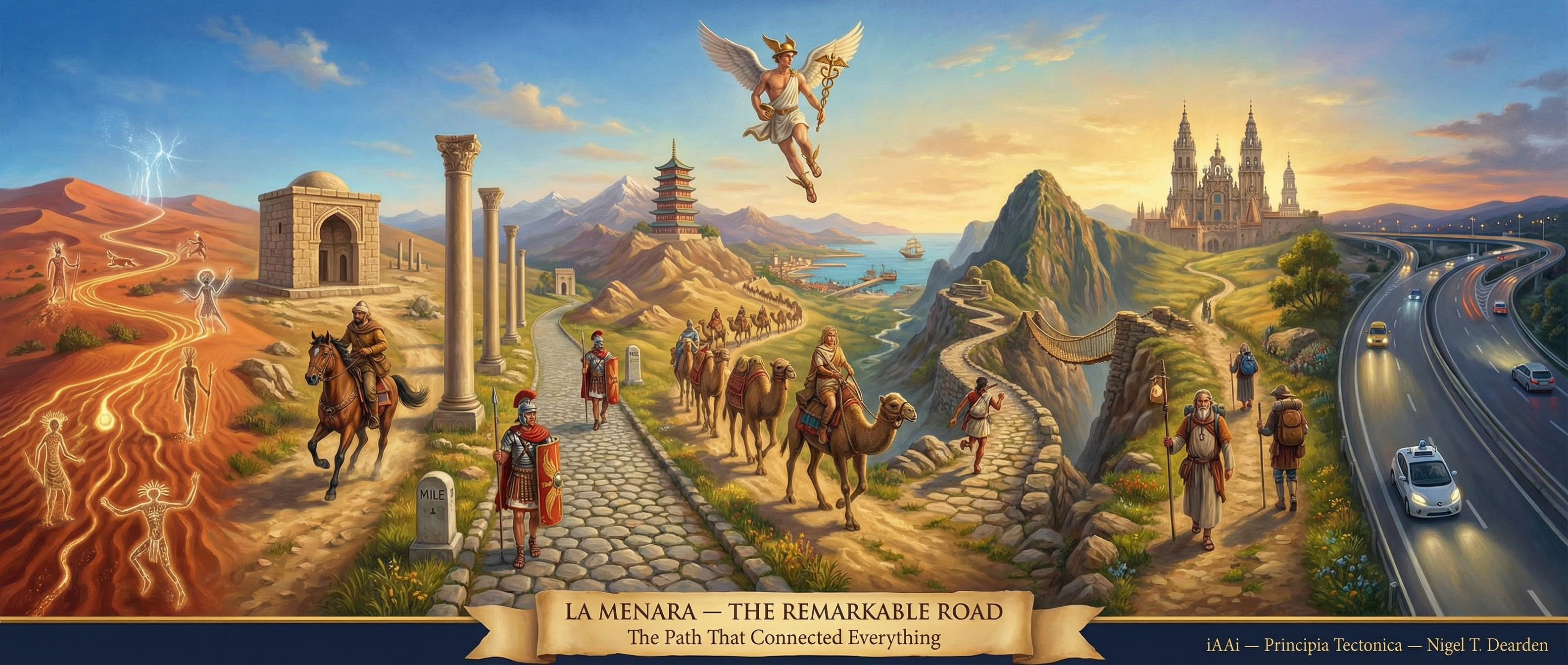
La Menara — The Remarkable Road: From Songlines to Smart Roads