

RELAY 2: TREE
Settlement — The Regenerator
From the ignition of intent came the anchoring of place. Calories became surplus, and villages rose from the soil. Humanity shifted from wandering bands to fixed societies, while outriders remained as mobile counterpoints — two modes of continuity, each vital to the civilisational weave. Irrigation channels carved permanence into the land, granaries stored the surplus of survival, and walls defined the first boundaries of order. Infrastructure was no longer improvised; it became deliberate, engineered into permanence. In this relay, mankind learned that stability itself could be designed — the foundation stone upon which higher consciousness would one day rise.
ACTIVE WEBS
ENERGY WEB
Wood as fuel and material resource
KNOWLEDGE WEB
Woodworking and construction techniques
POWER WEB
Control of forests and timber resources
ICUT FOUR PILLARS
INFRASTRUCTURE
Wooden shelters, tools, boats, and structures
CONTINUITY
Sustainable forest management and knowledge transmission
UNIFICATION
Shared settlements and communal structures
THREATS
Deforestation, fire, resource scarcity
HISTORICAL SIGNIFICANCE
Timeline: Approximately 100,000 to 50,000 years ago, with significant development continuing through the Neolithic period.
Impact: Enabled semi-permanent settlements, improved tool-making, facilitated maritime exploration, and created the foundation for agricultural infrastructure.
Legacy: Wood remains a critical material. From construction to energy, from furniture to paper, wood infrastructure continues to shape modern civilisation.
LA MENARA — THE REMARKABLE TREE
385 Million Years of Infrastructure — Food · Shelter · Medicine · Mythology · Law · Spirituality
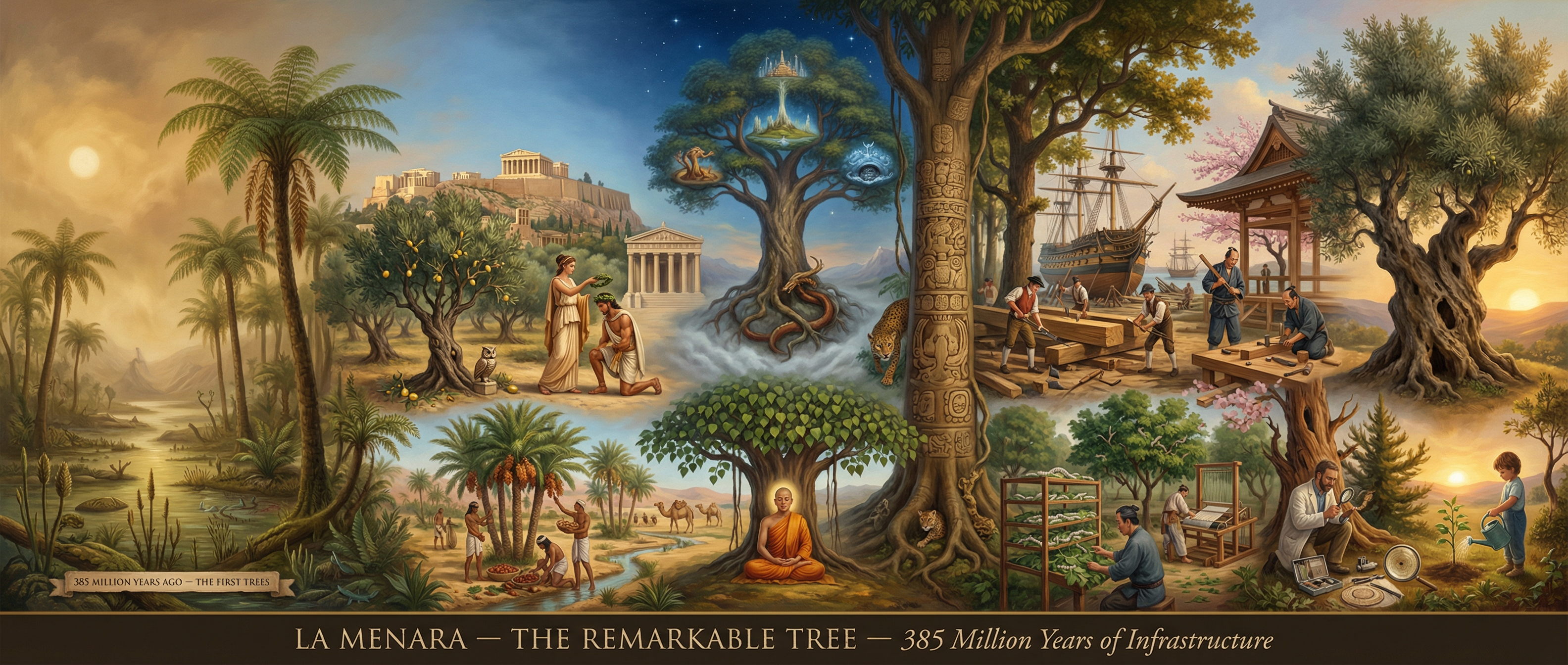
La Menara — From Devonian forests to Athena's olive, Yggdrasil to the Bodhi Tree, Royal Navy oak to the ancient Vouves olive still bearing fruit
The Tree relay in An Infrastructure Odyssey rightly begins with timber, shelter, and construction — but the cultural significance of trees extends far deeper. Long before the first human hand reached for a branch, trees had already spent 385 million years engineering the planet. The earliest tree-like plants — Wattieza — appeared in the Middle Devonian period. By the Carboniferous, vast forests had colonised the continents, drawing down CO₂, generating the oxygen-rich atmosphere that would sustain animal life, and laying down the coal seams that would fuel the Industrial Revolution 300 million years later. Trees did not merely inhabit the Earth; they terraformed it.
What makes trees extraordinary as infrastructure is the multi-output processing chain each species enables. The apple yields fresh fruit, dried fruit, juice, cider, vinegar, pectin, and animal feed — seven products from one organism. The olive delivers food, oil, lamp fuel, soap, medicine, and timber. The coconut — "the tree of a thousand uses" in Sanskrit — provides water, milk, oil, coir fibre, timber, charcoal, and toddy. The date palm, domesticated 6,000 years ago in the Persian Gulf, was described by Kew Gardens as having "uses as many as days in the year." Each tree is not a crop; it is a micro-factory.
Across every civilisation, trees occupy the centre of the cosmological map. Yggdrasil (Norse ash) connects nine worlds. The Bodhi Tree (sacred fig) witnessed Buddha's enlightenment. Athena's olive won patronage of Athens over Poseidon's spring. The Ceiba (Maya) connects underworld, earth, and heavens. Willow bark gave us aspirin (3000 BCE), cinchona bark gave us quinine, and yew bark gives us Taxol for cancer treatment today. Frankincense and myrrh — aromatic gum resins harvested by cutting the bark of Boswellia and Commiphora trees across the Arabian Peninsula, India, and Africa — have been prized for over 6,000 years for their medicinal, spiritual, and trade significance. Ancient Egyptian papyri prescribed frankincense for inflammation; myrrh was central to embalming and wound treatment. These tree-derived resins were so valuable they were offered alongside gold to kings, and modern pharmacology has confirmed their anti-inflammatory and antimicrobial properties. Solon's Athens imposed the death penalty for destroying an olive tree. Ireland's Brehon Laws classified trees into four legal categories. England's Forest Charter of 1217 — companion to Magna Carta — guaranteed common people's access to forest resources.
"He that plants trees loves others besides himself." — Thomas Fuller (1732)
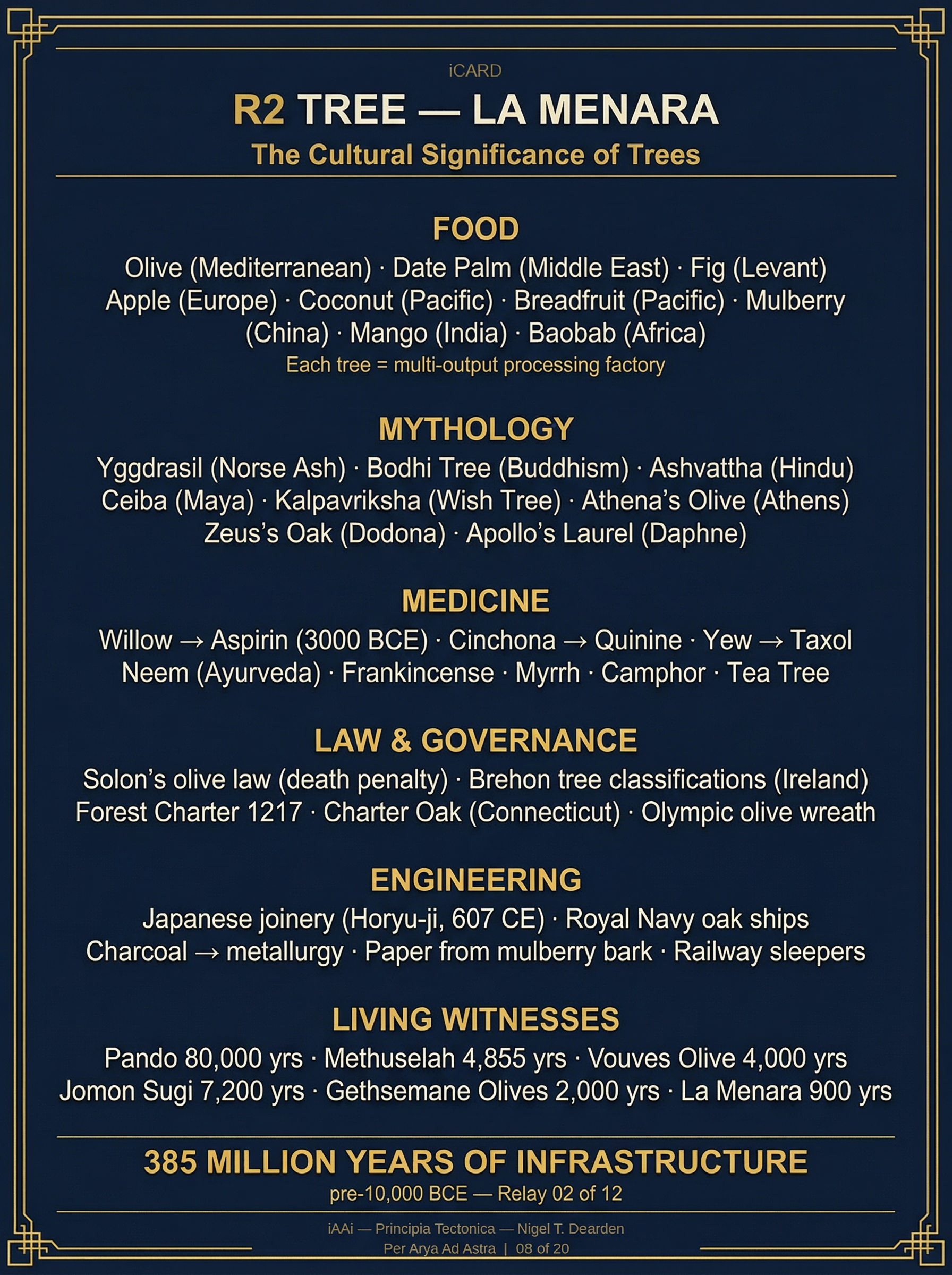
iCARD R02 — La Menara: The Cultural Significance of Trees
THE COUNTERPARTS: TREE
How West, East, and Outrider each approached tree infrastructure

The Counterparts — Relay 02: Tree