


RELAY 3: RIVER
Exchange — The Flow Master
From surplus came movement, and from movement came connection. Trade webs stretched across continents, binding distant peoples into a single fabric. Steppe outriders became the bridges between East and West, carrying goods, ideas, and intent across vast horizons. Roads carved through wilderness, caravans crossed deserts, and ships traced the edges of oceans — each route an artery of civilisation. Infrastructure was no longer local; it became global, weaving cultures into shared continuity. In this relay, mankind discovered that exchange itself was a form of infrastructure — a network of possibility, carrying not only wealth but the seeds of higher consciousness beyond the limits of ego and isolation.
ACTIVE WEBS
ENERGY WEB
Water power and agricultural productivity
KNOWLEDGE WEB
Hydraulic engineering and agricultural science
EXCHANGE WEB
Trade along river systems
POWER WEB
Control of water resources and agricultural surplus
ICUT FOUR PILLARS
INFRASTRUCTURE
Irrigation canals, dams, reservoirs, water management
CONTINUITY
Maintenance of water systems across generations
UNIFICATION
Coordinated labor and centralized administration
THREATS
Droughts, floods, system failure, resource conflict
HISTORICAL SIGNIFICANCE
Timeline: Approximately 10,000 to 5,000 years ago, with the development of major river civilisations.
Impact: Enabled the agricultural surplus that supported cities, writing systems, organized religion, and complex governance. River civilisations became the cradles of human civilisation.
Legacy: Water infrastructure remains critical. From hydroelectric power to irrigation to urban water systems, river infrastructure continues to determine civilisational success.
LA MENARA — THE REMARKABLE RIVER
“The highest good is like water. Water gives life to the ten thousand things and does not strive.” — Lao Tzu
The River relay occupies a pivotal position in An Infrastructure Odyssey. Where Fire gave humanity energy and Tree gave humanity material, River gave humanity location — the answer to the fundamental question of where to build. Every major civilisation in human history arose on the banks of a river: the Nile gave Egypt its annual miracle of black soil; the Tigris and Euphrates cradled Sumer, the world's first literate society; the Indus nurtured Harappa's astonishing urban planning; the Yellow River forged the identity of China; and the Ganges became the spiritual spine of an entire subcontinent.
But water's cultural significance extends far beyond irrigation and transport. Every civilisation deified its rivers — from Hapi, the androgynous Egyptian god who poured the Nile from twin urns, to Ganga, who descended from heaven on Shiva's hair, to the Dragon Kings who governed China's waterways from crystal palaces beneath the waves. Water was law: the Code of Hammurabi (c. 1750 BCE) devoted entire sections to irrigation rights, and Roman aquae ductus created the legal framework for public water that persists in modern municipal law.
Perhaps most remarkably, water inspired civilisations that built without trees. The Marsh Arabs (Ma'dan) of southern Iraq have lived in the Mesopotamian Marshes for over 5,000 years, constructing magnificent Mudhif reed cathedrals — enormous parabolic arches made entirely of bundled Qasab reeds, floating on water, without a single tree, nail, or piece of glass. On the other side of the world, the Uru people of Lake Titicaca independently developed the same solution, building entire floating islands and houses from totora reeds at 3,812 metres altitude. These parallel innovations demonstrate that water infrastructure is a universal human instinct.
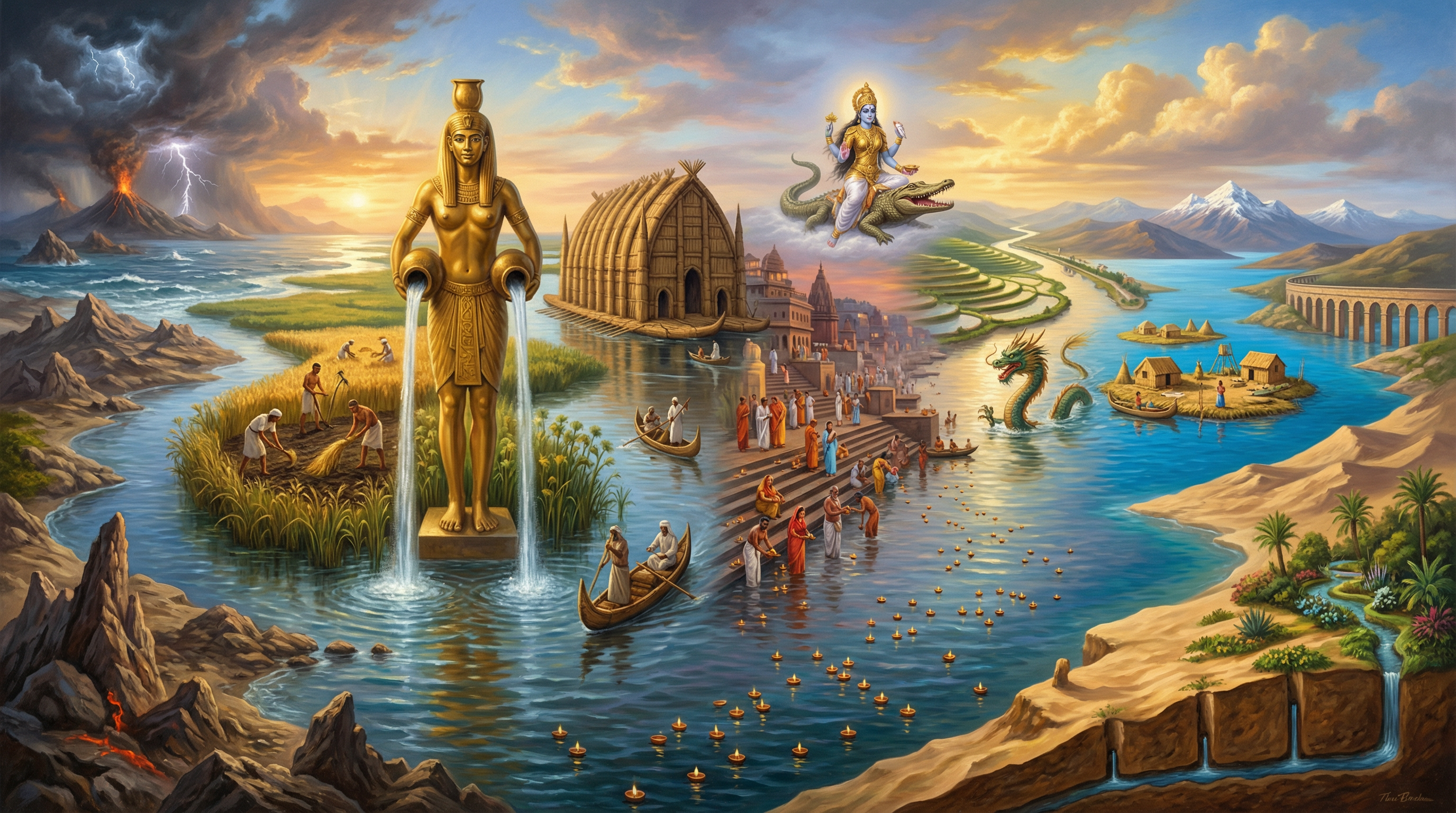
La Menara — 4.4 Billion Years of Water as Infrastructure: From primordial oceans to the Nile, Marsh Arab reed cathedrals, Varanasi ghats, Chinese Dragon Kings, Uru floating islands, and Persian qanats
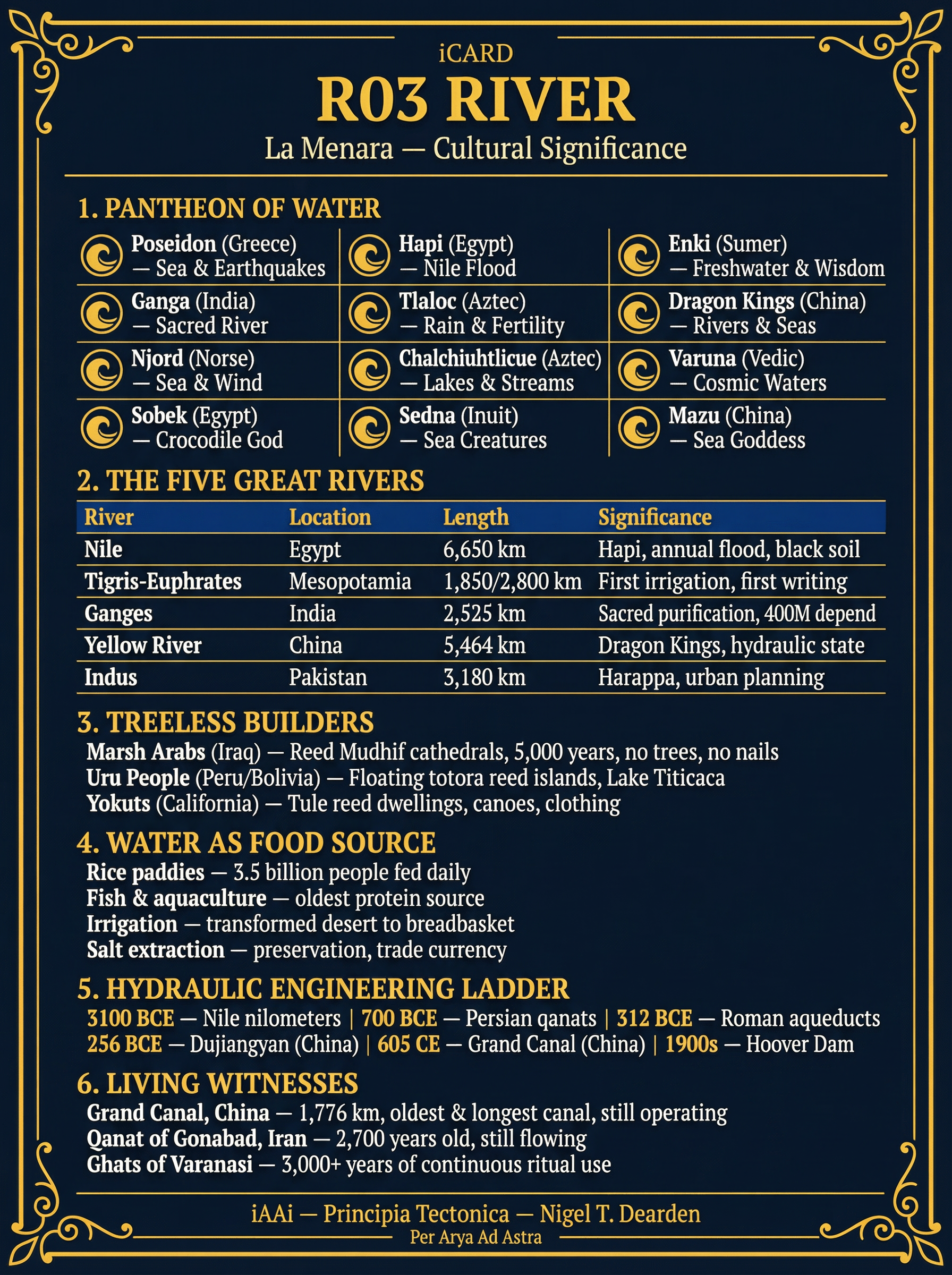
iCard R03: River — La Menara Cultural Significance
THE COUNTERPARTS: RIVER
How West, East, and Outrider each approached river infrastructure

The Counterparts — Relay 03: River