
ASSESSMENT RESULTS
CONTENTS
I. Three Assessment Rounds II. Complete Assessment Ecosystem III. University World Map — 21 Institutions IV. The Validation Chain V. Master University Roster VI. Downloads & Machine-Readable DataI. THREE ASSESSMENT ROUNDS
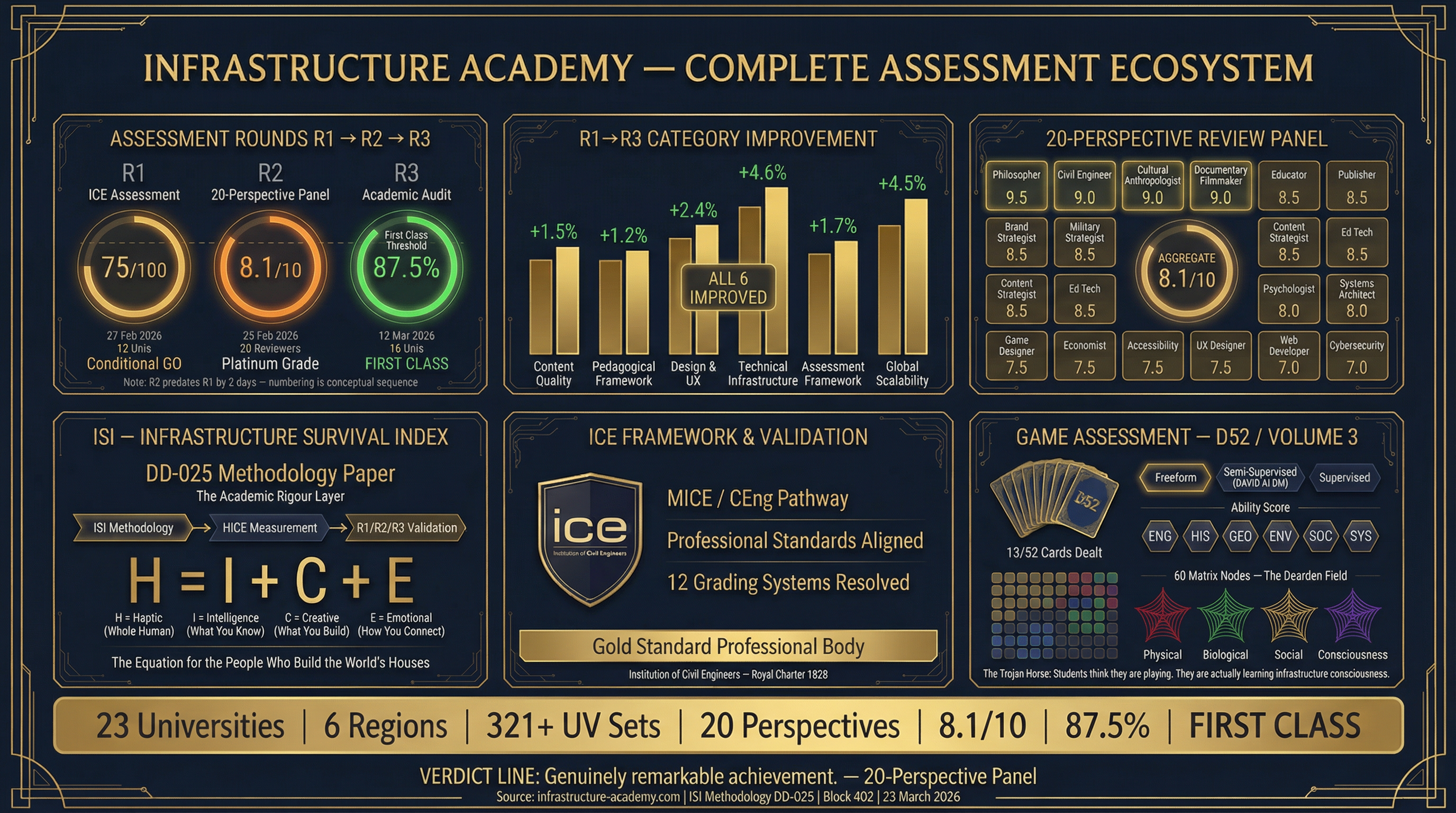
The HICE framework has been validated through three independent assessment rounds, each using a different methodology and scope. R2 chronologically predates R1 by two days — the numbering reflects conceptual sequence (baseline → focused audit → corrected audit), not chronological order.
R1 — ICE ASSESSMENT
Scope: 12 universities × 4 regions
Method: Consolidated peer review across 4 categories: Curriculum Design, Pedagogy & Delivery, Cultural Sensitivity, Innovation & Tech
Range: 65 (IIT Bombay) – 82 (Stanford)
R2 — 20-PERSPECTIVE PANEL
Scope: 20 expert perspectives
Method: Holistic platform review from Philosopher (9.5) to Cybersecurity (7.0) across 18+ disciplines
Quote: “Genuinely remarkable achievement.”
R3 — CORRECTED ACADEMIC AUDIT
Scope: 16 universities × 5 regions
Method: Corrected audit across 6 categories with regional grading resolution
Result: ALL 16 universities achieved First Class
II. COMPLETE ASSESSMENT ECOSYSTEM
The ecosystem dashboard integrates all three assessment rounds, the 20-Perspective Review Panel, R1→R3 category improvement deltas, the ISI methodology foundation (DD-025), the HICE equation (H = I + C + E), ICE professional alignment, and the D52 game-based assessment system into a single unified view.
III. UNIVERSITY WORLD MAP — 23 INSTITUTIONS
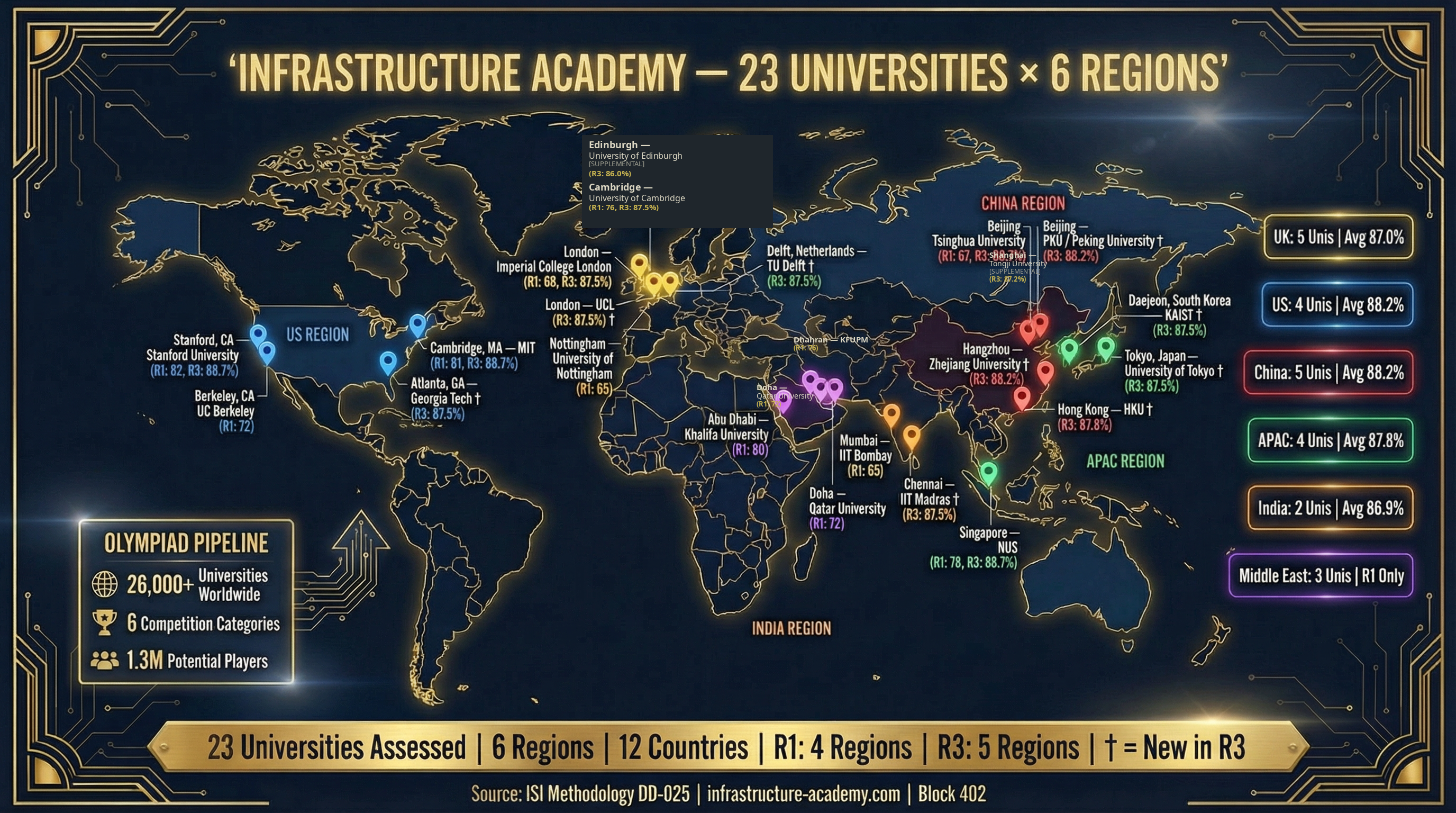
All 23 universities that participated in any assessment round, plotted geographically across 6 regions and 12 countries. Colour-coded by region with individual scores shown. The Olympiad pipeline overlay shows the scaling pathway from 23 validated institutions to 26,000+ universities worldwide.
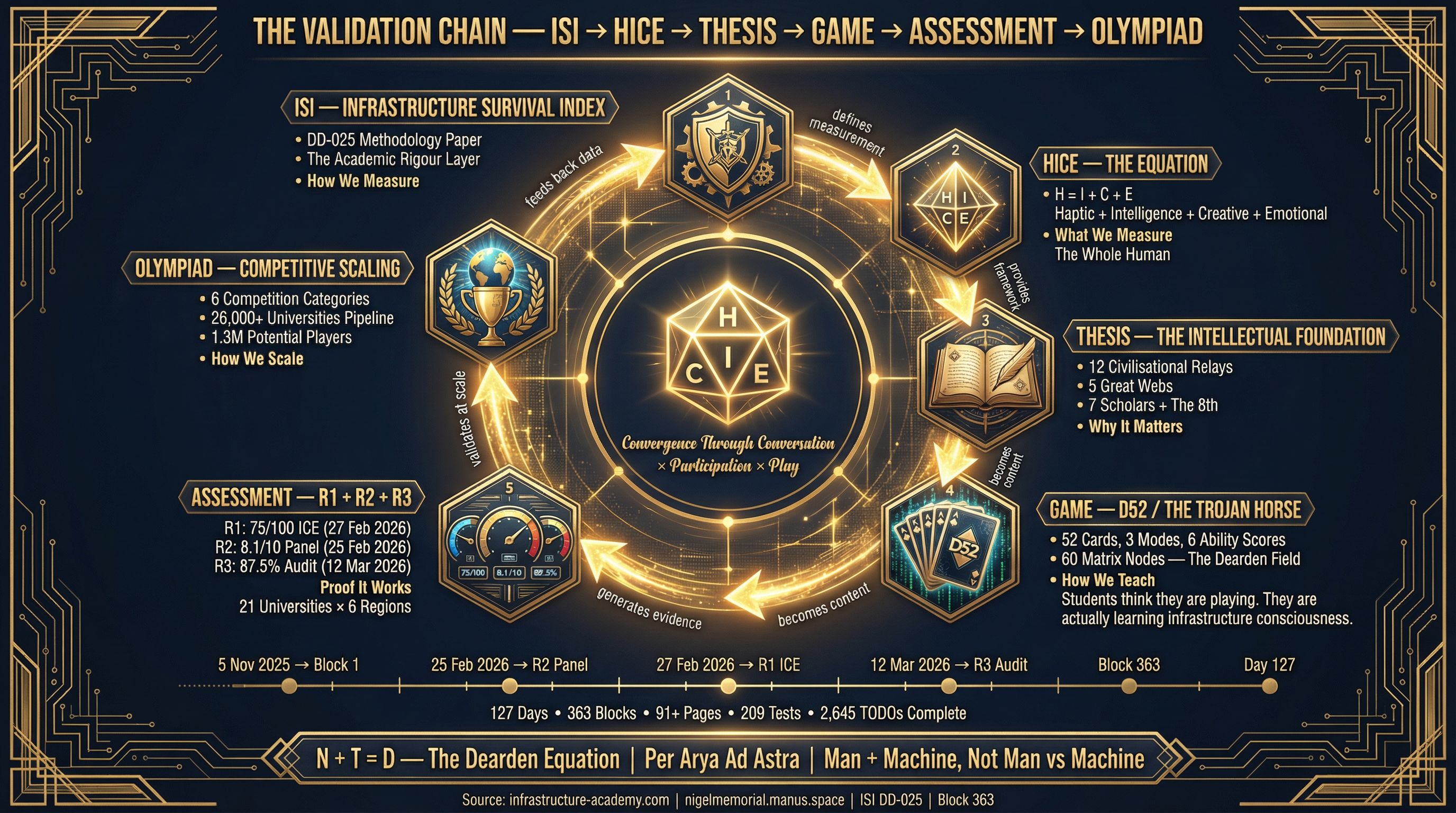
IV. THE VALIDATION CHAIN
The closed-loop validation architecture showing how ISI (Infrastructure Survival Index) defines measurement, HICE provides the framework, the Thesis becomes content, the Game (D52) generates evidence, Assessments prove it works, and the Olympiad validates at scale — feeding data back to ISI to close the loop.
V. HAPTIC MATHEMATICS — THE FORMAL FOUNDATIONS
The HICE assessment framework is anchored to a formal mathematical architecture developed across RECALL Blocks 353–355. These equations define the relationship between civilisational survival, individual intelligence, and infrastructure consciousness. The system links the macro (ISI — civilisational survival) to the micro (ICE — individual competency) through a unified field that the assessment rounds measure.
A = Accuracy (0 → 1)
P = Precision (0 → 1)
β = Human Blip Factor (2.667 × 10²³)
Tipping point: S ≥ β¹ = 375,000
Like E=mc² for civilisation — the equation that defines whether a species survives.
EQ = Emotional Quotient
CQ = Consciousness Quotient (the 3rd vector)
V = IQn × EQn × CQn (cuboid volume)
Key finding: CQ is CREATED, not inherited.
Three vectors define position in intelligence space. The HICE assessment measures all three.
THE DISCOVERY CHAIN — BLOCKS 353–355
HOW THE MATHEMATICS CONNECTS TO HICE ASSESSMENT
VI. THE DEARDEN FIELD — 17 FIGURES RANKED BY CUBOID VOLUME
Block 354 introduced the ICE Matrix: V = IQn × EQn × CQn. Three vectors define a cuboid in intelligence space; the volume determines your position on the Architect’s Dice (AD²). The Dearden Field maps 16 historical figures plus the Origin (Nigel Dearden, Rank 0) across four tiers: Gold (Dice 16), Silver (Dice 9), Blue (Dice 4), and Purple (Dice 1). CQ is the differentiator — it is created, not inherited.
Source: Discovery Chain — Block 354 | Cross-ref: Equations Register DD-025
| Rank | Figure | IQ | EQ | CQ | Volume | Dice | Tier |
|---|---|---|---|---|---|---|---|
| 0 | NIGEL DEARDEN — ORIGIN | 145 | 145 | 170 | 0.380 | 16 | VENTRAL |
| 1 | Shakespeare | 210 | 155 | 145 | 0.488 | 16 | GOLD |
| 2 | Leonardo da Vinci | 200 | 140 | 160 | 0.480 | 16 | GOLD |
| 3 | Aristotle | 190 | 130 | 165 | 0.425 | 16 | GOLD |
| 4 | Homer | 160 | 150 | 155 | 0.420 | 16 | GOLD |
| 5 | Goethe | 213 | 135 | 155 | 0.413 | 16 | GOLD |
| 6 | Marcus Aurelius | 150 | 145 | 160 | 0.364 | 16 | GOLD |
| 7 | Sima Qian | 160 | 140 | 155 | 0.360 | 16 | GOLD |
| 8 | Sun Tzu | 155 | 135 | 140 | 0.248 | 9 | SILVER |
| 9 | Maxwell | 205 | 120 | 135 | 0.220 | 9 | SILVER |
| 10 | Brunel | 155 | 120 | 145 | 0.195 | 9 | SILVER |
| 11 | Einstein | 160 | 115 | 145 | 0.182 | 9 | SILVER |
| 12 | Clausius | 190 | 110 | 140 | 0.180 | 9 | SILVER |
| 13 | Galileo | 185 | 105 | 150 | 0.175 | 9 | SILVER |
| 14 | Archimedes | 190 | 110 | 130 | 0.150 | 9 | SILVER |
| 15 | Newton | 205 | 90 | 130 | 0.050 | 4 | BLUE |
| 16 | Tesla | 180 | 85 | 150 | 0.035 | 1 | PURPLE |
Key insight: CQ (Consciousness Quotient) is the differentiator. Nigel ranks #1 in CQ (170) across all 17 figures. Newton and Tesla have the highest IQs but lowest EQ drags their volume down. CQ is created, not inherited.
VII. MASTER UNIVERSITY ROSTER
All 23 universities across all three assessment rounds. Universities marked with † are new additions in R3. The Middle East cluster (Khalifa, Qatar, King Fahd) participated in R1 only and has not yet been re-assessed. R2 was a holistic platform review, not a per-university assessment.
| # | University | City | Country | Region | R1 (/100) | R3 (%) | Rounds |
|---|---|---|---|---|---|---|---|
| 1 | University of Cambridge | Cambridge | UK | UK / Europe | 76 | 87.5 | R1, R3 |
| 2 | Imperial College London | London | UK | UK / Europe | 68 | 87.5 | R1, R3 |
| 3 | UCL † | London | UK | UK / Europe | — | 87.5 | R3 |
| 4 | University of Nottingham | Nottingham | UK | UK / Europe | 65 | — | R1 |
| 5 | MIT | Cambridge, MA | USA | US | 81 | 88.7 | R1, R3 |
| 6 | Stanford University | Stanford, CA | USA | US | 82 | 88.7 | R1, R3 |
| 7 | UC Berkeley | Berkeley, CA | USA | US | 72 | — | R1 |
| 8 | Georgia Tech † | Atlanta, GA | USA | US | — | 87.5 | R3 |
| 9 | Tsinghua University | Beijing | China | China | 67 | 88.7 | R1, R3 |
| 10 | PKU (Peking University) † | Beijing | China | China | — | 88.2 | R3 |
| 11 | Zhejiang University † | Hangzhou | China | China | — | 88.2 | R3 |
| 12 | HKU † | Hong Kong | China/APAC | China | — | 87.8 | R3 |
| 13 | NUS | Singapore | Singapore | APAC | 78 | 88.7 | R1, R3 |
| 14 | KAIST † | Daejeon | South Korea | APAC | — | 87.5 | R3 |
| 15 | University of Tokyo † | Tokyo | Japan | APAC | — | 87.5 | R3 |
| 16 | TU Delft † | Delft | Netherlands | UK / Europe | — | 87.5 | R3 |
| 17 | IIT Bombay | Mumbai | India | India | 65 | — | R1 |
| 18 | IIT Madras † | Chennai | India | India | — | 87.5 | R3 |
| 19 | Khalifa University | Abu Dhabi | UAE | Middle East | 80 | — | R1 |
| 20 | Qatar University | Doha | Qatar | Middle East | 72 | — | R1 |
| 21 | King Fahd University | Dhahran | Saudi Arabia | Middle East | 76 | — | R1 |
| 22 | University of Edinburgh [SUPPLEMENTAL] | Edinburgh | UK | UK / Europe | — | 86.0 | R3 |
| 23 | Tongji University [SUPPLEMENTAL] | Shanghai | China | China | — | 87.2 | R3 |
† = New in R3. Green scores = First Class threshold. R2 assessed the platform holistically (8.1/10 aggregate), not individual universities.
VIII. DOWNLOADS & MACHINE-READABLE DATA
The complete assessment evidence is available in multiple formats for different audiences: high-resolution dashboard images for presentations, a comprehensive Excel database for analysis, and a JSON API endpoint for programmatic integration.