

RELAY 11: ORBIT
PILLAR I: IDENTIFY
Observational — What happened? What are the key facts?
Era: Space Age
Object: Satellite
Archetype: The Astronaut
Energy Type: Orbital
Active Web: Consciousness Web
PILLAR II: UNDERSTAND
Educational — Why did it happen? What can we learn?
Key Inventions & Technologies
| Innovation | Significance |
|---|---|
| The Rocket | Reaction propulsion for reaching orbit. |
| The Satellite (Sputnik) | First artificial orbital object. |
| The Microprocessor | Integrated computing on a chip. |
| GPS | Global Positioning System. |
Biomimicry & Natural Blueprints
Seed Dispersal (Ballistics)
→ Rocket launch trajectories and orbital mechanics for efficient payload delivery.
Principle: Ballistics, Orbital Mechanics
Planetary Rings (Debris)
→ Understanding and managing space debris (Kessler Syndrome).
Principle: Orbital Mechanics, Environmental Engineering
Ecosystems (Life Support)
→ Closed-loop life support systems mimicking Earth's natural ecosystems.
Principle: Bioengineering, Environmental Engineering
PILLAR III: MANAGE & CONTROL
Application — How do we apply this knowledge?
The Sun Tzu Lens
Tactical Dispositions — the high ground of space offers the ultimate tactical advantage. A nation that controls orbit can observe the entire globe and strike anywhere. The Nine Situations — space is
PILLAR IV: THESIS & VISION
What does this mean for the future?
Personal Vignette
Watching a rocket launch from Cape Canaveral — the ground shaking, the sky splitting — humanity reaching for the stars.
The Handoff
From orbit, humanity gained the planetary perspective — seeing Earth as a single system for the first time. But the view from space raised the deepest question: could humanity connect not just machines, but minds?
LA MENARA — THE REMARKABLE ORBIT
Satellites · Space Stations · Planetary Infrastructure — Cultural Significance Across the Five Webs
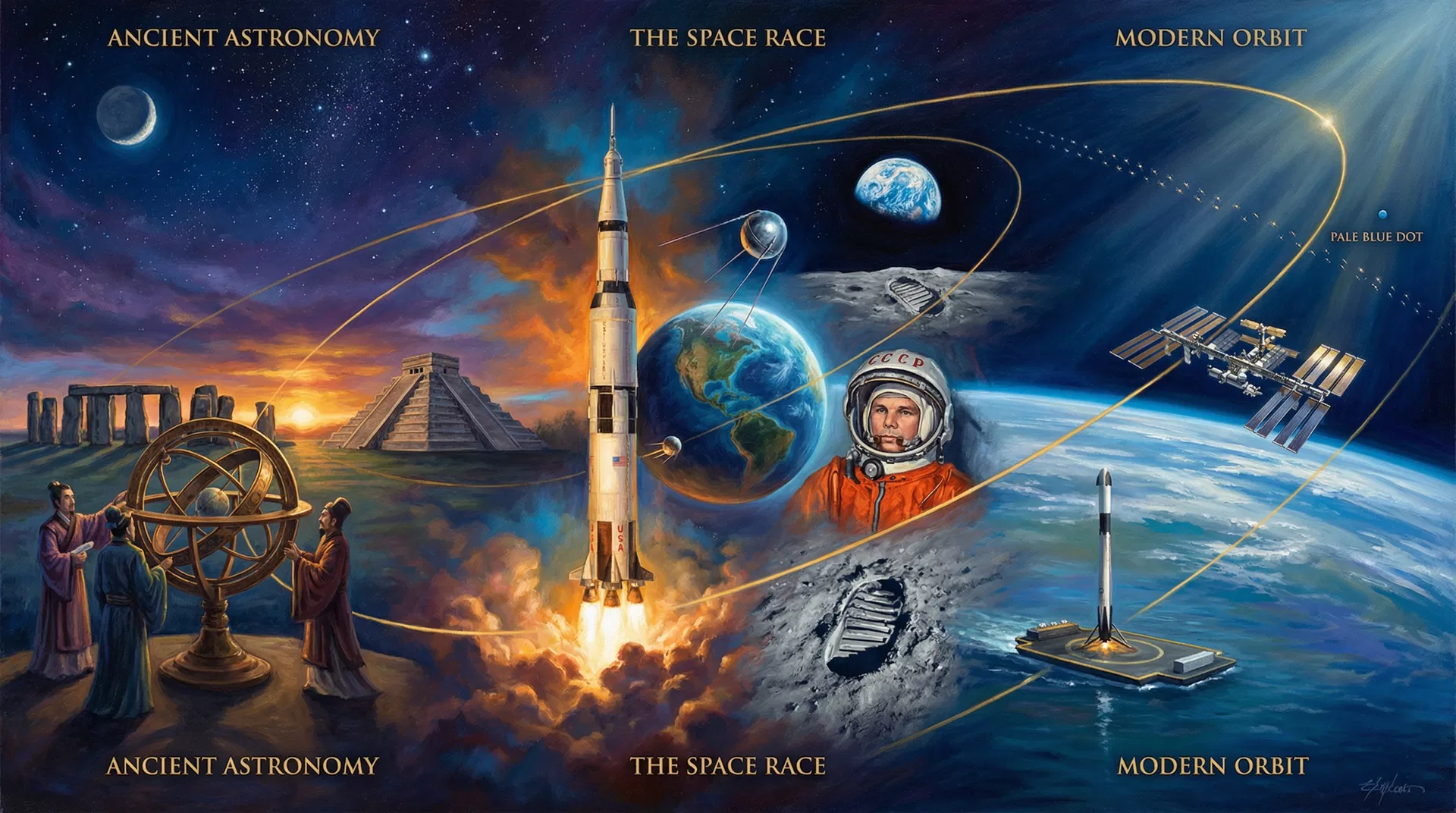
La Menara — The Cultural History of Orbit: From Ancient Astronomy to the ISS and Beyond
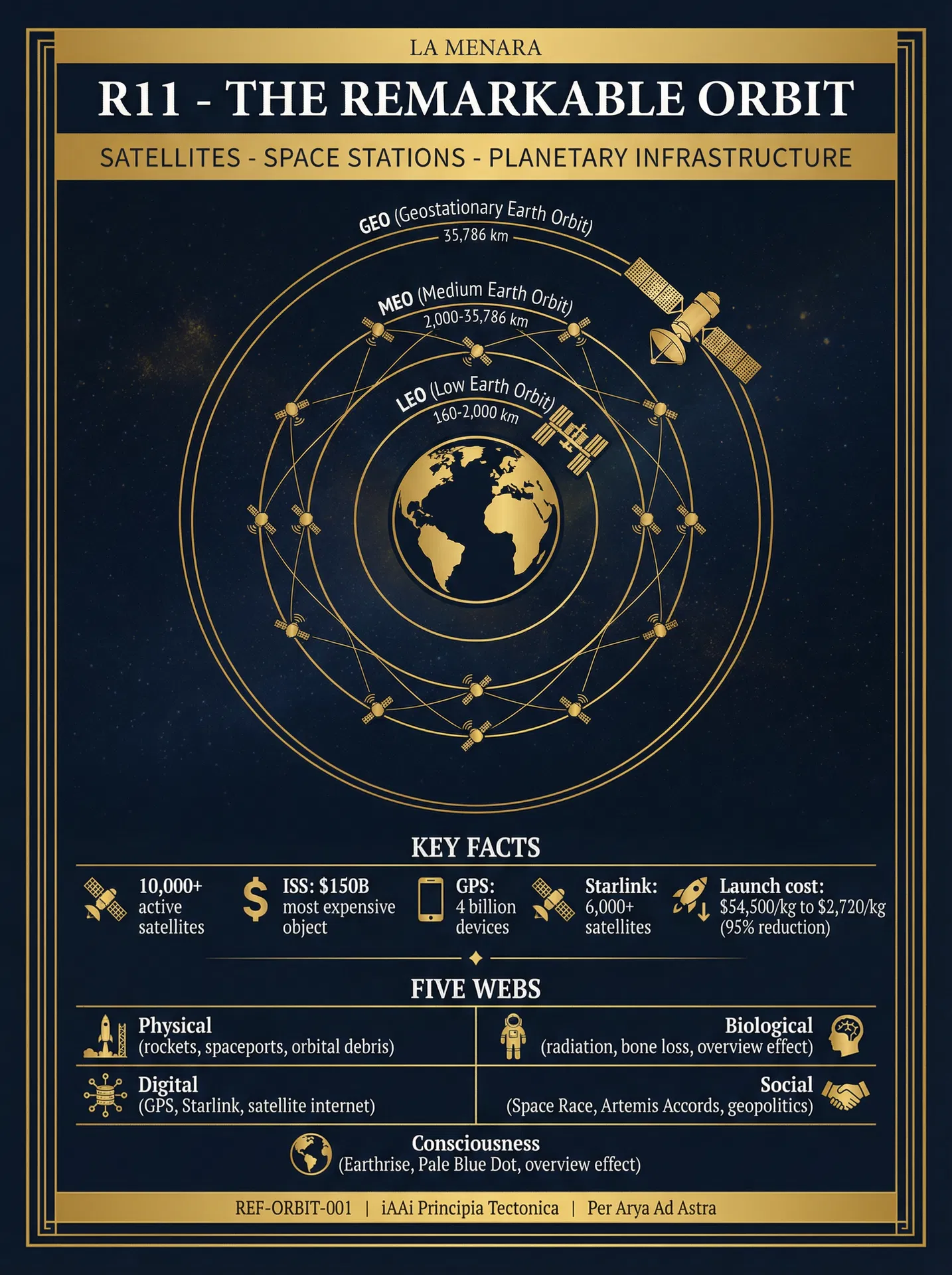
iCard R11 — Orbit Cultural Significance