

RELAY 08: RAIL
PILLAR I: IDENTIFY
Observational — What happened? What are the key facts?
Era: Industrial Revolution
Object: Track
Archetype: The Industrialist
Energy Type: Steam
Active Web: Energy Web
PILLAR II: UNDERSTAND
Educational — Why did it happen? What can we learn?
Key Inventions & Technologies
| Innovation | Significance |
|---|---|
| Steam Locomotive | Steam-powered rail engine. |
| Signaling Systems | Visual/electrical traffic control. |
| Standard Gauge | Uniform track width (4 ft 8.5 in). |
| Railway Time | Synchronized network clocks. |
| The Fishplate | Rail joint connector. |
| Steel Rails | Durable track system replacing iron. |
| Air Brakes | Compressed air braking. |
| Janney Coupler | Automatic train coupling. |
Biomimicry & Natural Blueprints
Circulatory Systems
→ Branching railway networks from main lines to feeder routes, optimizing distribution.
Principle: Network Theory, Logistics, Fluid Dynamics
Skeletal Structures
→ Bridge and tunnel design inspired by arch of bone and tensile strength of spider silk.
Principle: Structural Engineering, Materials Science
Aerodynamics of Animals
→ High-speed train forms emulating birds or fish to reduce drag.
Principle: Fluid Dynamics, Aerodynamics
Ant Colony Optimization
→ Complex logistics of scheduling and routing trains inspired by ant foraging strategies.
Principle: Optimization Algorithms, Swarm Intelligence
PILLAR III: MANAGE & CONTROL
Application — How do we apply this knowledge?
The Sun Tzu Lens
Sun Tzu
PILLAR IV: THESIS & VISION
What does this mean for the future?
Personal Vignette
Standing on the platform at Darlington, where the first public railway began — feeling the vibration of approaching trains and the pulse of industrial civilisation.
The Handoff
From the railway, humanity learned the power of networks and standardization. But the rail could only carry goods — to transform raw materials into finished products, humanity needed the loom.
LA MENARA — THE REMARKABLE RAIL
Cultural Significance Reference — Five Webs Analysis
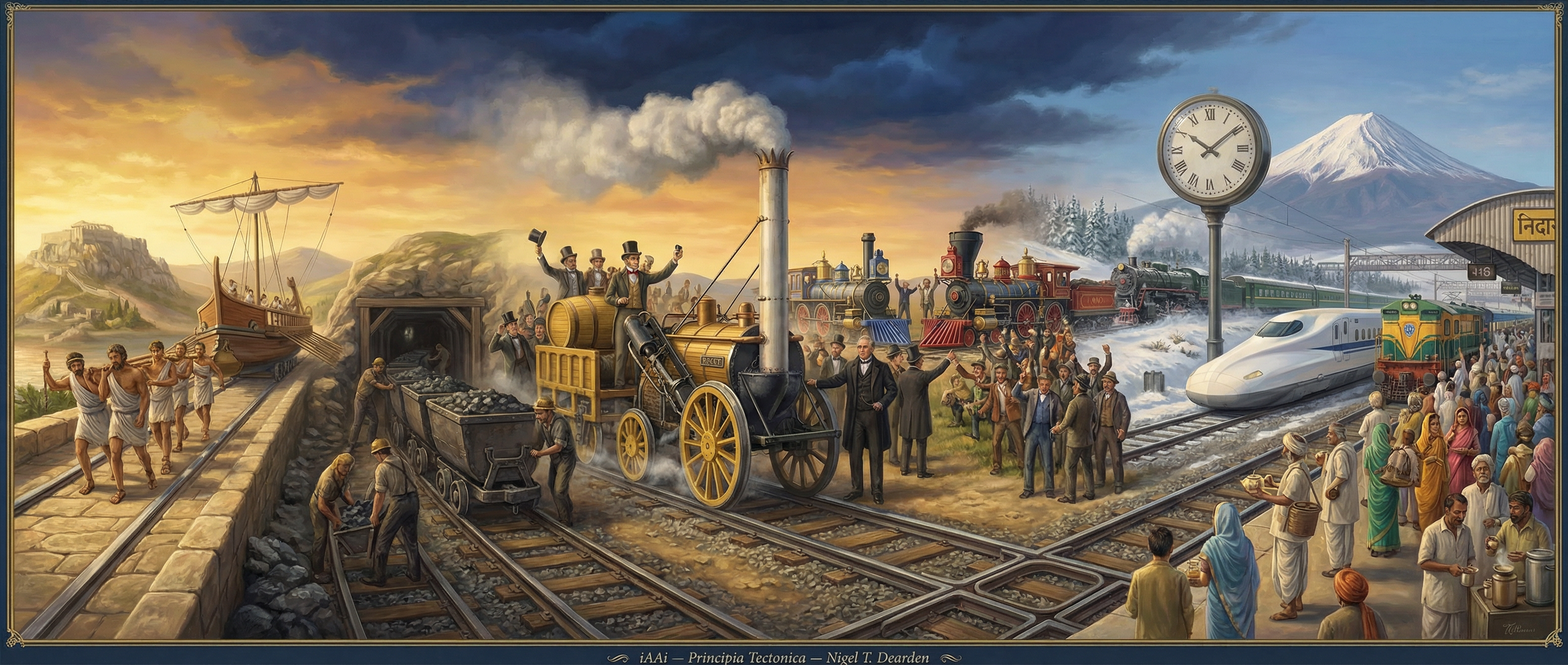
La Menara — The Cultural History of Rail