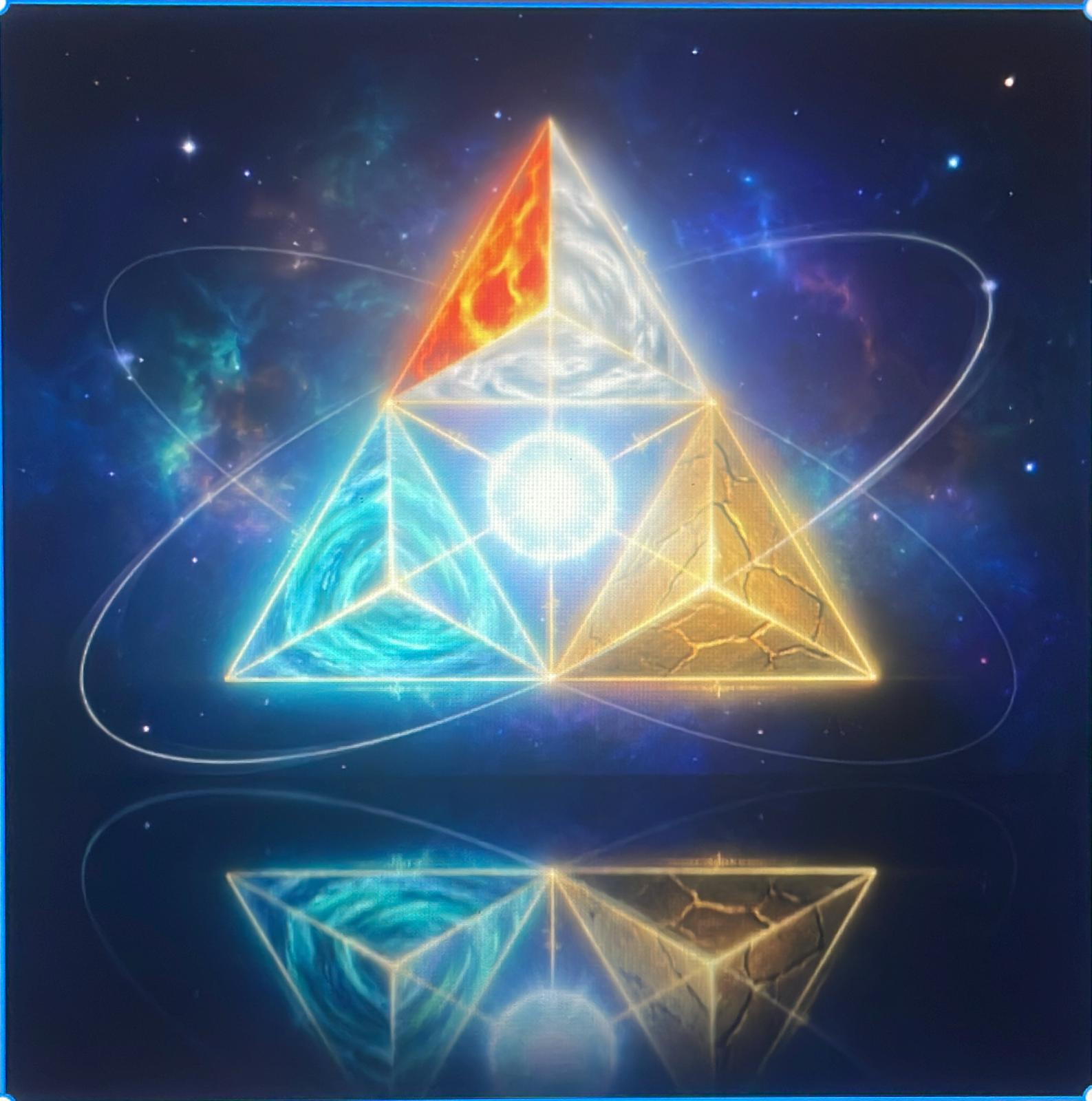


RELAY 5: ROADS
Collapse — The Storyteller
Every ascent carries its shadow. Civilisations that reached their zenith — Rome, Han, Maya — fell into silence. The perennial threats struck with precision: depletion of resources, wars of ambition, plagues of disease, and the division of unity into fragments. Infrastructure that once proclaimed permanence crumbled into ruins, aqueducts dried, temples emptied, and cities became echoes. Yet collapse was never the end; it was a relay, a fracture that revealed lessons etched in stone. In this chapter, mankind learned that continuity demands vigilance, and that collapse itself becomes the reminder that design must be restored, renewed, and carried forward.
ACTIVE WEBS
EXCHANGE WEB
Trade networks and commerce
KNOWLEDGE WEB
Transmission of ideas and culture
POWER WEB
Military logistics and imperial control
CONSCIOUSNESS WEB
Shared culture and civilisation
ICUT FOUR PILLARS
INFRASTRUCTURE
Road networks, way stations, supply depots, communication systems
CONTINUITY
Maintenance systems and road administration
UNIFICATION
Empire-wide connectivity and shared culture
THREATS
Banditry, maintenance failure, political fragmentation
HISTORICAL SIGNIFICANCE
Timeline: Approximately 2,500 to 1,500 years ago, with the development of major imperial road systems.
Impact: Enabled the creation of continental empires, facilitated long-distance trade, and unified diverse populations under single political systems. Road networks became the defining infrastructure of empires.
Legacy: Modern transportation networks—highways, railways, shipping lanes, air routes—are the direct descendants of ancient road systems. The principles of network design established by ancient roads continue to shape modern infrastructure.
LA MENARA — THE REMARKABLE ROAD
The Path That Connected Everything — Across the Five Webs
Before the first stone was laid on the Via Appia, before Darius stretched his Royal Road from Susa to Sardis — there were paths. The Aboriginal Songlines of Australia, 60,000 years old, are the longest continuous navigational tradition in human history: an oral GPS encoded in song. The road is the platform that carries every other relay. Fire travels as charcoal, trees as timber, horses gallop, ships dock at ports that roads connect to. To build a road is to declare: this place matters, and it is connected to everywhere else.
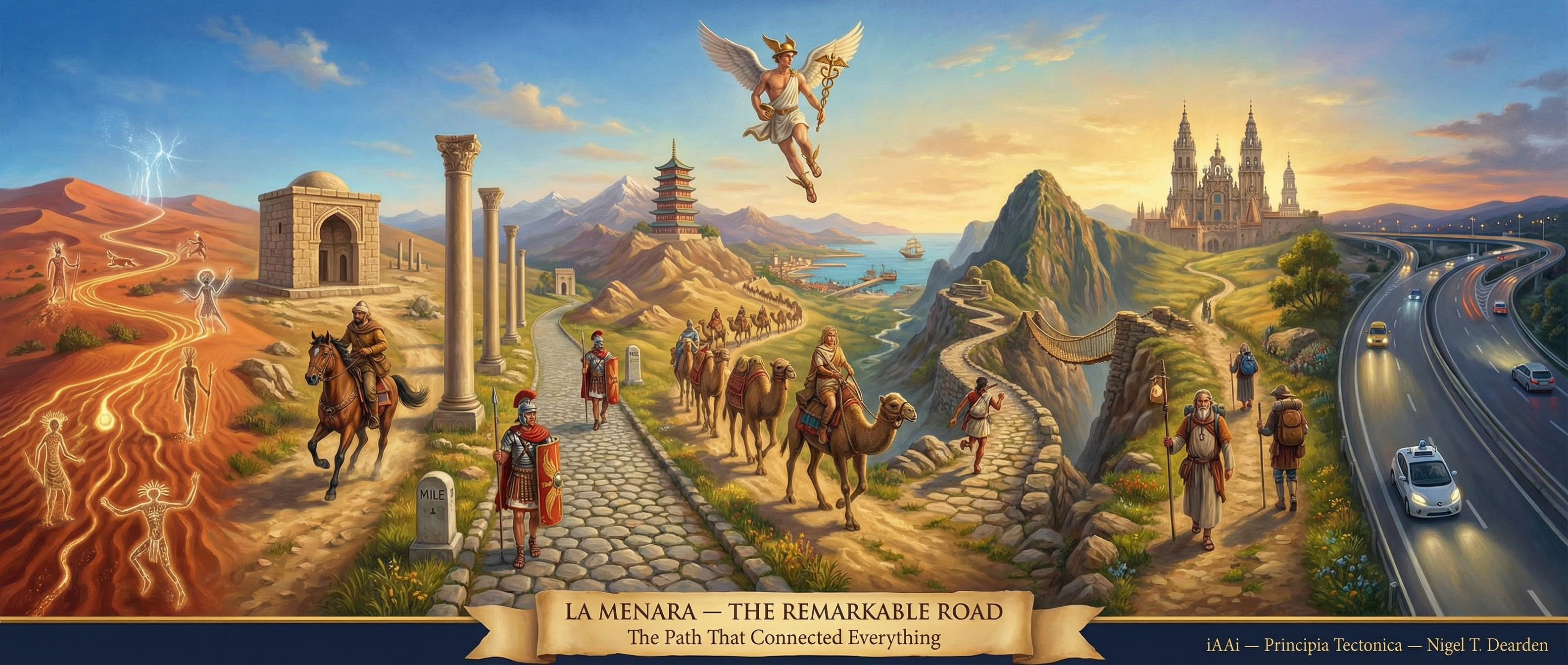
La Menara — The Remarkable Road: From Songlines to Smart Roads
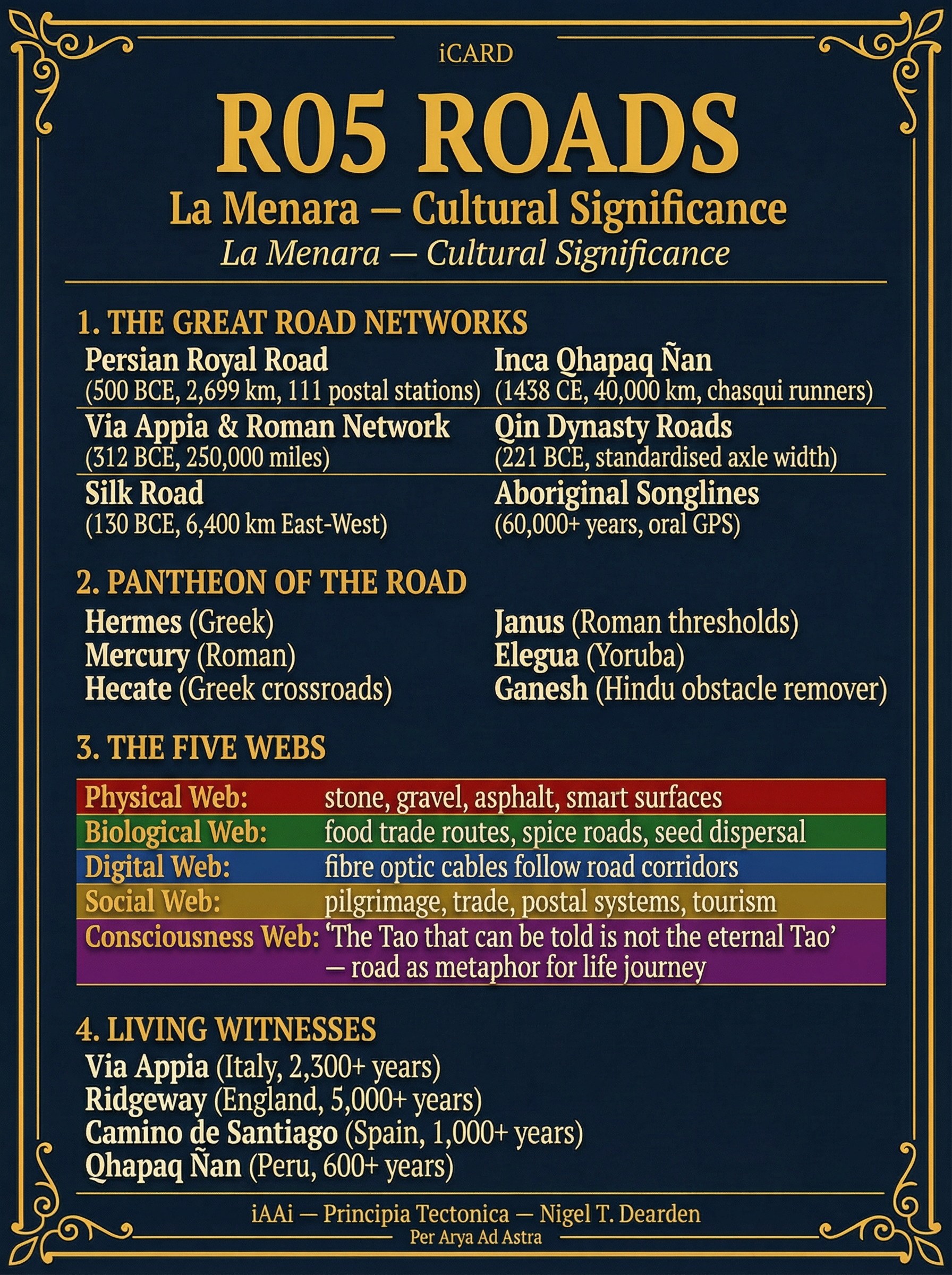
iCard R05 — Roads: La Menara Cultural Significance
THE COUNTERPARTS: ROADS
How West, East, and Outrider each approached roads infrastructure

The Counterparts — Relay 05: Roads