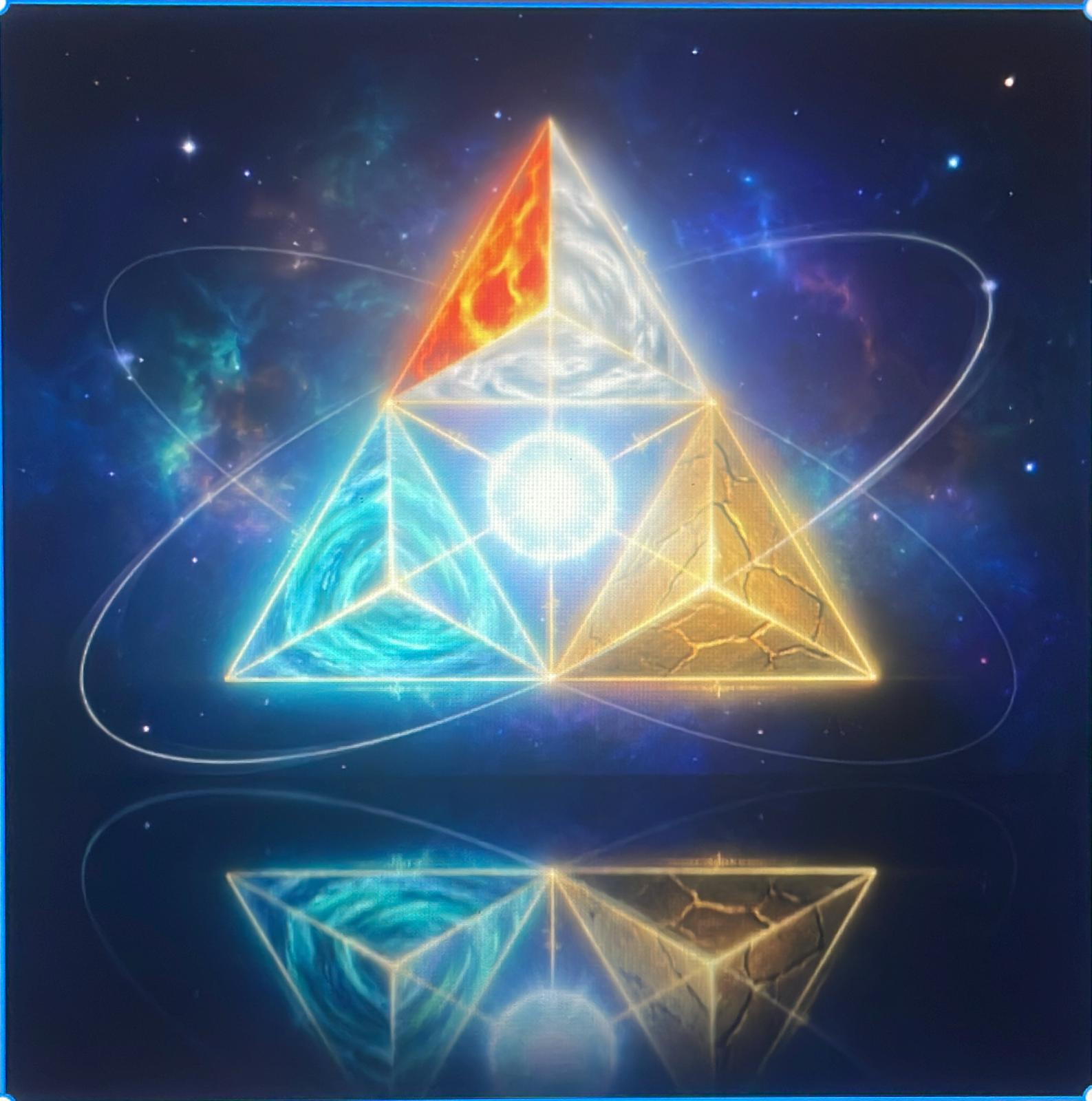


VOLUME 2: GUIDE — SECTIONS
Four sections of Volume 2: Guide that provide the practical analytical framework — from identification to thesis
THE FOUR SECTIONS
Each section adds a layer of depth to the Guide
Identify the 5 Webs and 4 Pillars in each relay. The IUMS framework applied systematically.
Writing systems, number systems, materials & mediums. The infrastructure of knowledge itself.
Practical application of the framework. Per-relay IUMC analysis diagrams.
The Counterparts thesis, The Orbital Canopy, and The Digital Outrider Paradox. This section is currently restricted and will be published in a future release.
SECTION 1: IDENTIFY
Systematic identification of infrastructure across 12 relays

S1 IUMS Relays — Infrastructure, Unification, Management, Sustainability across all 12 relays
WHAT IT DOES
Section 1 applies the 5 Webs and 4 Pillars framework systematically to each of the 12 civilisational relays. For every relay, it identifies: what infrastructure was built, how continuity was maintained, what unified the system, and what threats emerged.
KEY TOPICS
- ✓ Pillar-web interactions per relay
- ✓ Three modes of continuity
- ✓ 4 Perennial Threats collapse cycle identification
- ✓ System dynamics mapping
- ✓ Comparative analysis across relays
SECTION 2: UNDERSTAND
The Knowledge Web — writing systems, number systems, materials & mediums

The Pen IS Infrastructure — the written word as the foundation of civilisational continuity

Opening Overture

Master Map — Complete Writing Systems

Materials & Mediums — Durability Hierarchy

Accounting Phase — Tokens & Tallies

Narrative Phase — Storytelling

Printing to Modern

Number Systems Evolution

Civil Engineering — Knowledge Infrastructure

Writing Systems Evolution — from cuneiform to digital
SECTION 3: MANAGE & CONTROL
IUMC Framework — per-relay analysis diagrams

S3 Education Framework — how the IUMC model applies to infrastructure management
IUMC PER-RELAY DIAGRAMS
Each relay analysed through the Identify, Understand, Manage & Control lens

Relay 2: Tree

Relay 3: River

Relay 4: Horse

Relay 5: Roads

Relay 6: Ships

Relay 7: Loom

Relay 8: Rail

Relay 9: Engine

Relay 10: AAA Triad

Relay 11: Orbit

Relay 12: Transition
SECTION 4: THE COUNTERPARTS
The thesis — a three-way comparison reflecting how West, East, and Outrider approached the same infrastructure challenges
This section contains restricted thesis material. Full content will be published in a future release. The framework and visual evidence below are provided as a preview.
THE THREE MODES
| DIMENSION | WEST | EAST | NOMAD |
|---|---|---|---|
| TYPE | Discontinuous / Built | Continuous / Built | Semi-Continuous / Temporary Works |
| PATTERN | Invention → Collapse → Reinvention | Invention → Refinement → Compounding | Deliberate Temporary Works |
| LIFECYCLE COST | Not paid — diverted to war | Paid continuously | Zero — nothing to maintain |
| ARCHETYPE | Alexander the Great | Qin Shi Huang | Genghis Khan |

The Three Modes: West, East, and Outrider across 12,000 years
THE COUNTERPARTS — PER RELAY
Each relay chapter concludes with The Counterparts — a three-way comparison

Relay 1: Fire

Relay 2: Tree

Relay 3: River

Relay 4: Horse

Relay 5: Roads

Relay 6: Ships

Relay 7: Loom

Relay 8: Rail

Relay 9: Engine
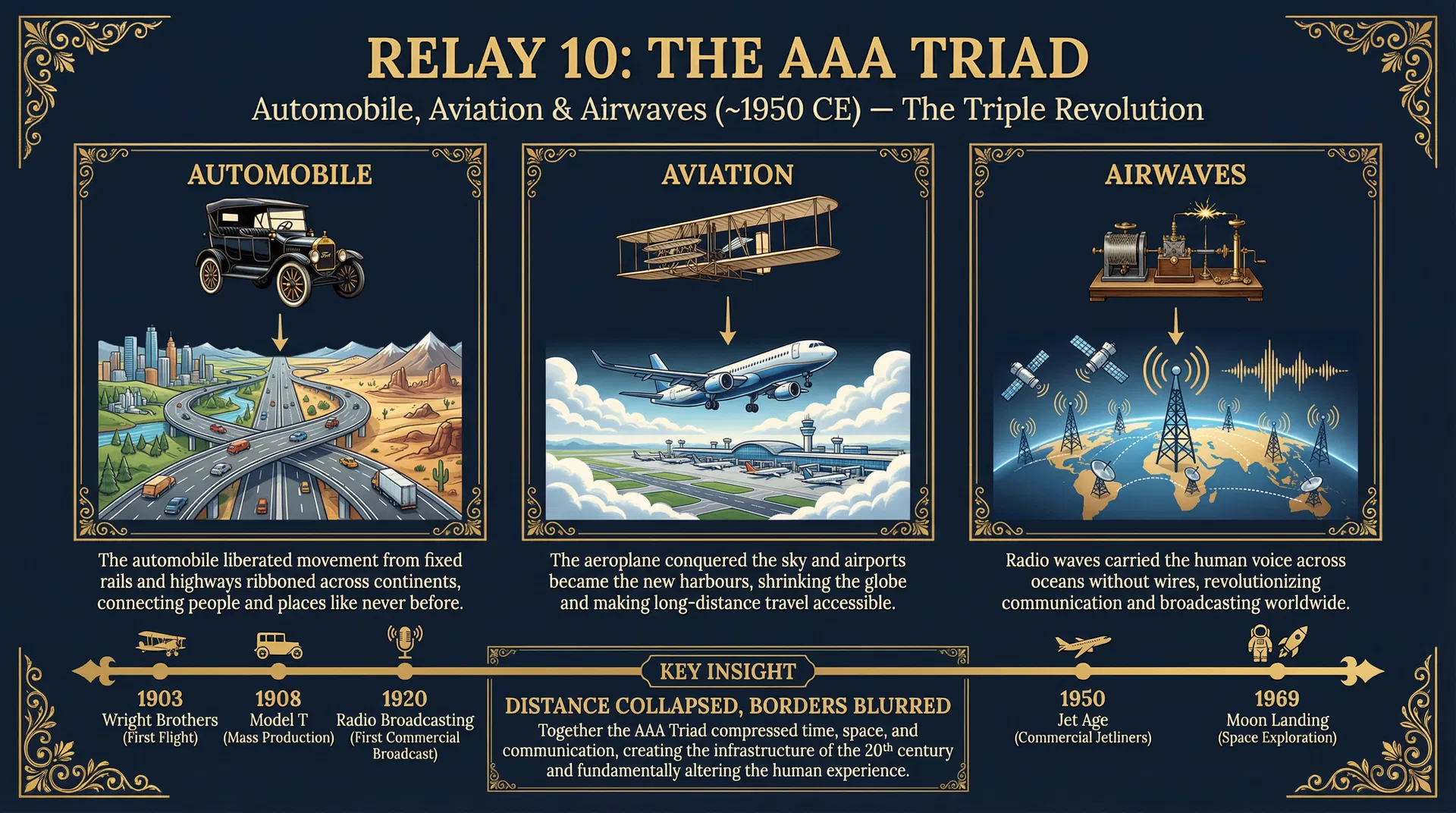
Relay 10: AAA Triad

Relay 11: Orbit

Relay 12: Human Nodes
THE COUNTERPARTS — THESIS EVIDENCE
Supporting evidence for the three civilisational modes

Mandate of Heaven — the Eastern continuity mechanism

Institutional Continuity — 2,000+ years of unbroken thread

Transformation Timeline — Century of Humiliation to resurgence

Sector Dominance — infrastructure investment at scale

Belt & Road Connectivity — the modern Silk Road

Civilisation Timeline — 12,000 years comparative

8 Billion People — the scale of the infrastructure challenge today

S4 Transformation Timeline — the complete transformation arc
THE DIGITAL OUTRIDER PARADOX
The steppe outrider reborn in the digital age
The steppe outrider was killed by rail and firearms — technologies that made the horse obsolete as a military platform. But the culture endures. And it was reborn as the Digital Outrider.
The digital outrider is the steppe outrider reborn — riding invisible infrastructure of bits and bytes, satellites and fibre optics they did not build. The new stealth: anywhere, everywhere, relying on orbital communication systems.
Yet here is the paradox: what the digital outrider gives in exchange is their data and digital footprint — which has enormous value to corporations and commerce. The steppe outrider extracted wealth from trade routes as toll collectors. The digital outrider is the toll — their data is the payment extracted by the platforms they ride. The hunter has become the hunted.
THE ORBITAL CANOPY
A visionary framework for humanity's future infrastructure
PLANETARY SCALE
Infrastructure that connects and sustains all of humanity at the planetary level. Global communication networks, planetary energy systems, and unified knowledge repositories.
SOLAR SCALE
Infrastructure that extends human presence throughout the solar system. Space-based energy collection, interplanetary communication networks, and resource extraction systems.
GALACTIC SCALE
Infrastructure that enables human presence at galactic scales. Interstellar communication, generation ships, and distributed consciousness networks.