


BEFORE WRITING
EXHIBIT GUIDE
I. PROTO-COUNTING & TALLY MARKS
43,000–8,000 BCE — The First Human Records
Before language, before writing, before cities, before agriculture — humans counted. The fundamental need to quantify — days, kills, lunar cycles, resources — was the first abstract thought. This pre-dates all known writing systems and formal languages by 35,000 years, revealing that numerical thinking is a foundational cognitive ability that evolved long before the ability to record spoken words.
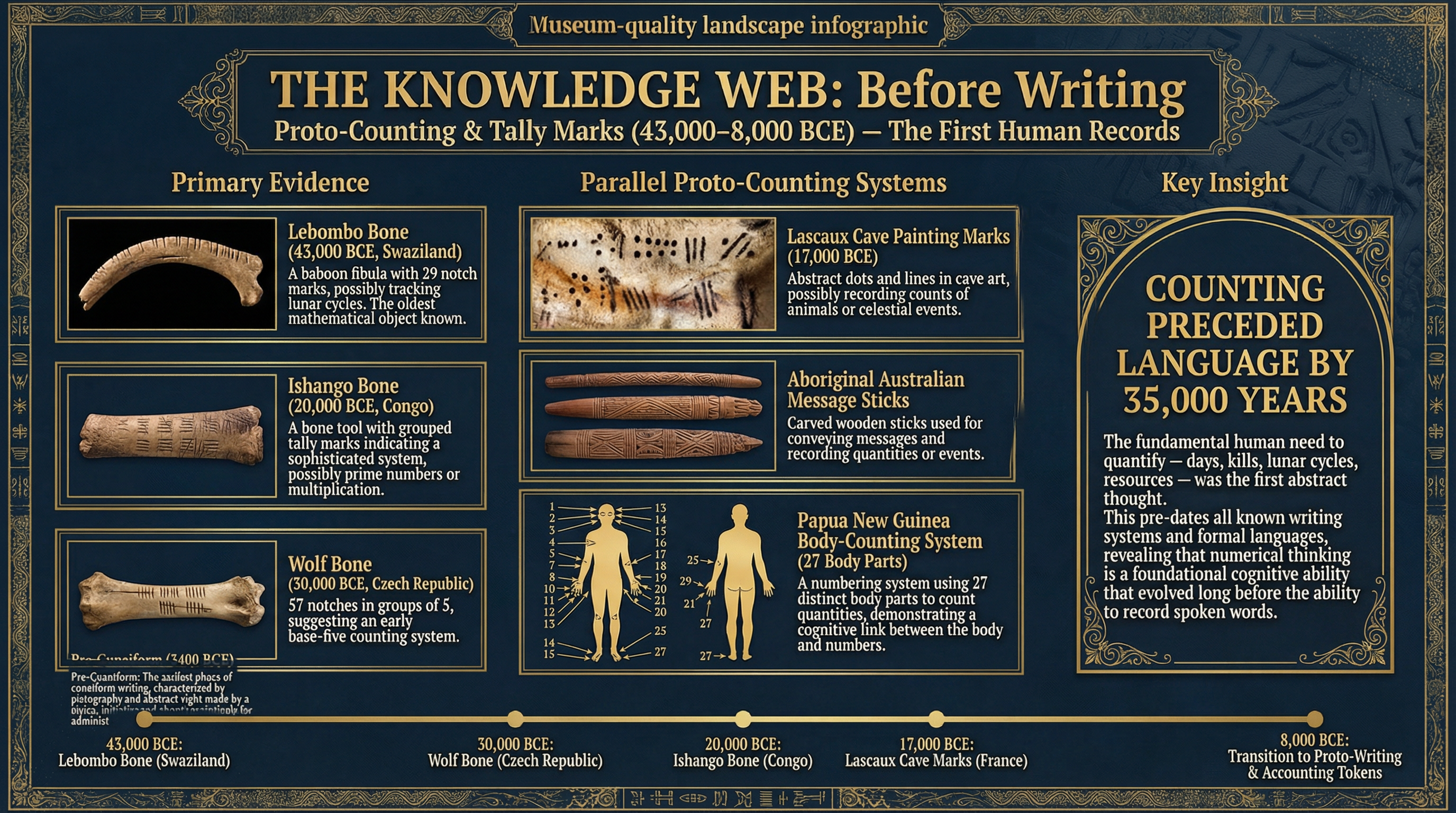
THE KNOWLEDGE WEB: Before Writing — Proto-Counting & Tally Marks (43,000–8,000 BCE)
PRIMARY EVIDENCE
| Artefact | Date | Location | Significance |
|---|---|---|---|
| Lebombo Bone | c. 43,000 BCE | Swaziland (Eswatini) | A baboon fibula with 29 notch marks, possibly tracking lunar cycles. The oldest known mathematical object. |
| Wolf Bone | c. 30,000 BCE | Czech Republic | 57 notches in groups of 5, suggesting an early base-five counting system. |
| Ishango Bone | c. 20,000 BCE | Congo | A bone tool with grouped tally marks indicating a sophisticated system, possibly prime numbers or multiplication. |
| Lascaux Cave Marks | c. 17,000 BCE | France | Abstract dots and lines in cave art, possibly recording counts of animals or celestial events. |
PARALLEL PROTO-COUNTING SYSTEMS
Proto-counting was not confined to one civilisation. Across the globe, independent cultures developed parallel systems for quantifying their world:
| System | Region | Method |
|---|---|---|
| Aboriginal Message Sticks | Australia | Carved wooden sticks used for conveying messages and recording quantities or events. |
| Body-Counting System | Papua New Guinea | A numbering system using 27 distinct body parts to count quantities, demonstrating a cognitive link between the body and numbers. |
| Quipu | Andes (South America) | Knotted string records used by the Inca Empire for accounting, census data, and narrative encoding. |
The fundamental human need to quantify — days, kills, lunar cycles, resources — was the first abstract thought. This pre-dates all known writing systems and formal languages, revealing that numerical thinking is a foundational cognitive ability that evolved long before the ability to record spoken words. The tally mark is the first infrastructure of thought.
II. CLAY TOKENS & BULLAE
8,000–3,500 BCE — The Birth of Accounting — Commerce Before Literature
The transition from tally marks to clay tokens represents one of the most consequential technological leaps in human history. For 4,600 years, all written records were purely numerical and accounting-based. Commerce, not literature, was the primary driver for the invention of writing. The merchant preceded the poet. The ledger preceded the epic.
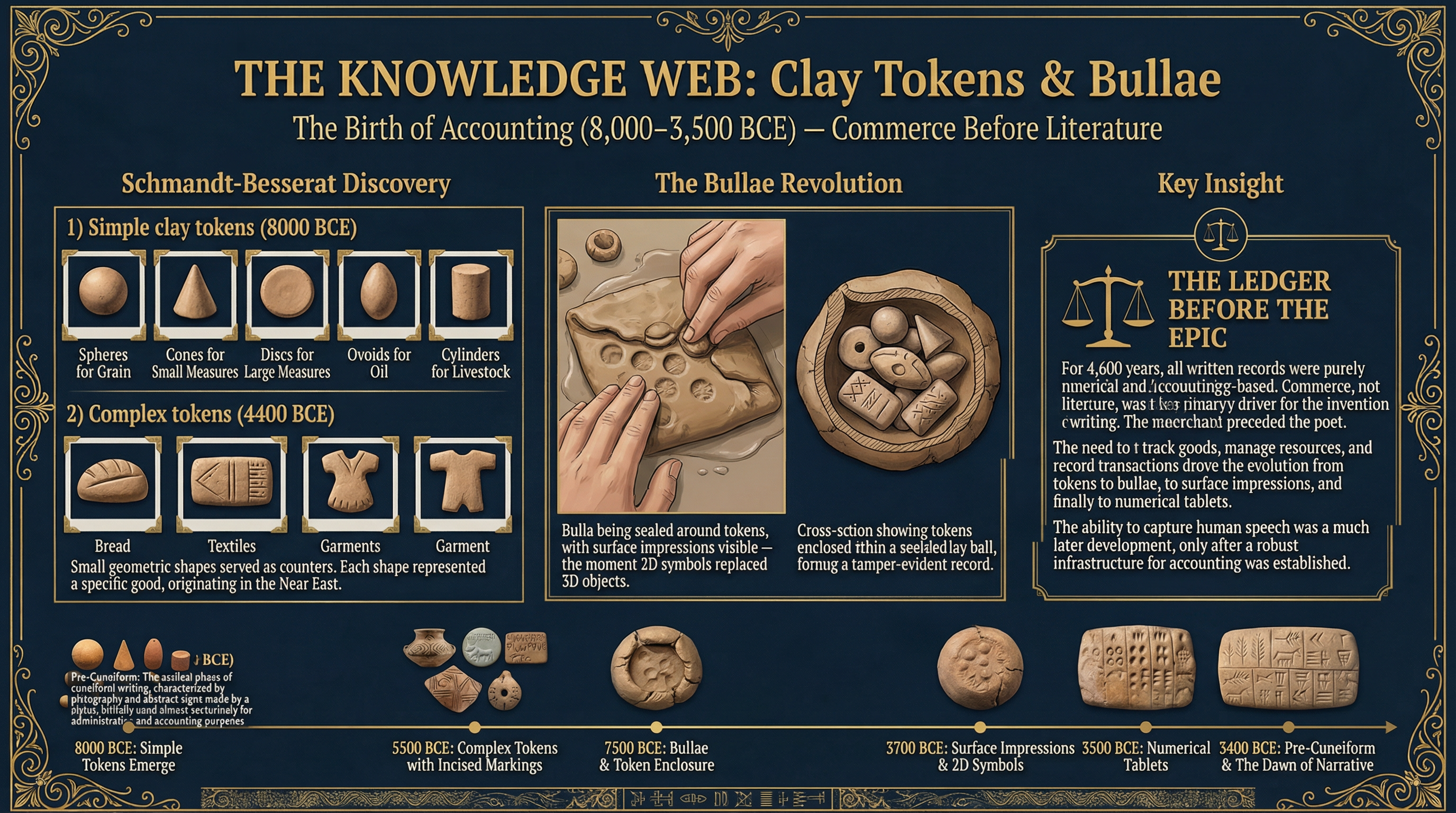
THE KNOWLEDGE WEB: Clay Tokens & Bullae — The Birth of Accounting (8,000–3,500 BCE)
THE SCHMANDT-BESSERAT DISCOVERY
Archaeologist Denise Schmandt-Besserat’s groundbreaking research revealed that the origins of writing lie not in storytelling but in accounting. Small geometric clay shapes — spheres, cones, discs, ovoids, cylinders — served as counters for specific goods. Each shape represented a commodity: spheres for grain, cones for small measures, discs for large measures, ovoids for oil, cylinders for livestock.
| Stage | Date | Innovation |
|---|---|---|
| Simple Tokens | c. 8,000 BCE | Small tangible objects used for counting specific goods like grain or livestock. |
| Complex Tokens | c. 4,400 BCE | More elaborate shapes with incised markings representing bread, textiles, garments — an expanding economy. |
| Bullae | c. 3,700 BCE | Hollow clay balls enclosing tokens — the first tamper-evident records. A sealed contract. |
| Surface Impressions | c. 3,500 BCE | Marks pressed onto the bulla surface before sealing — the moment 2D symbols replaced 3D objects. The birth of writing. |
For 4,600 years, all written records were purely numerical and accounting-based. Commerce, not literature, was the primary driver for the invention of writing. The merchant preceded the poet. The need to track goods, manage resources, and record transactions drove the evolution from tokens to bullae, to surface impressions, and finally to numerical tablets. The ability to capture human speech was a much later development, only after a robust infrastructure for accounting was established.
III. PROTO-NUMERALS TO SYMBOLS
3,500–3,000 BCE — The Bridge from Counting to Writing — Numbers Became Words
The final transformation — from physical counting objects to abstract written symbols — occurred across multiple civilisations simultaneously. This was not a single invention but a global parallel emergence, driven by the same underlying need: to record quantities at scale. The great transition from 3D tokens to 2D symbols is the moment infrastructure became information.
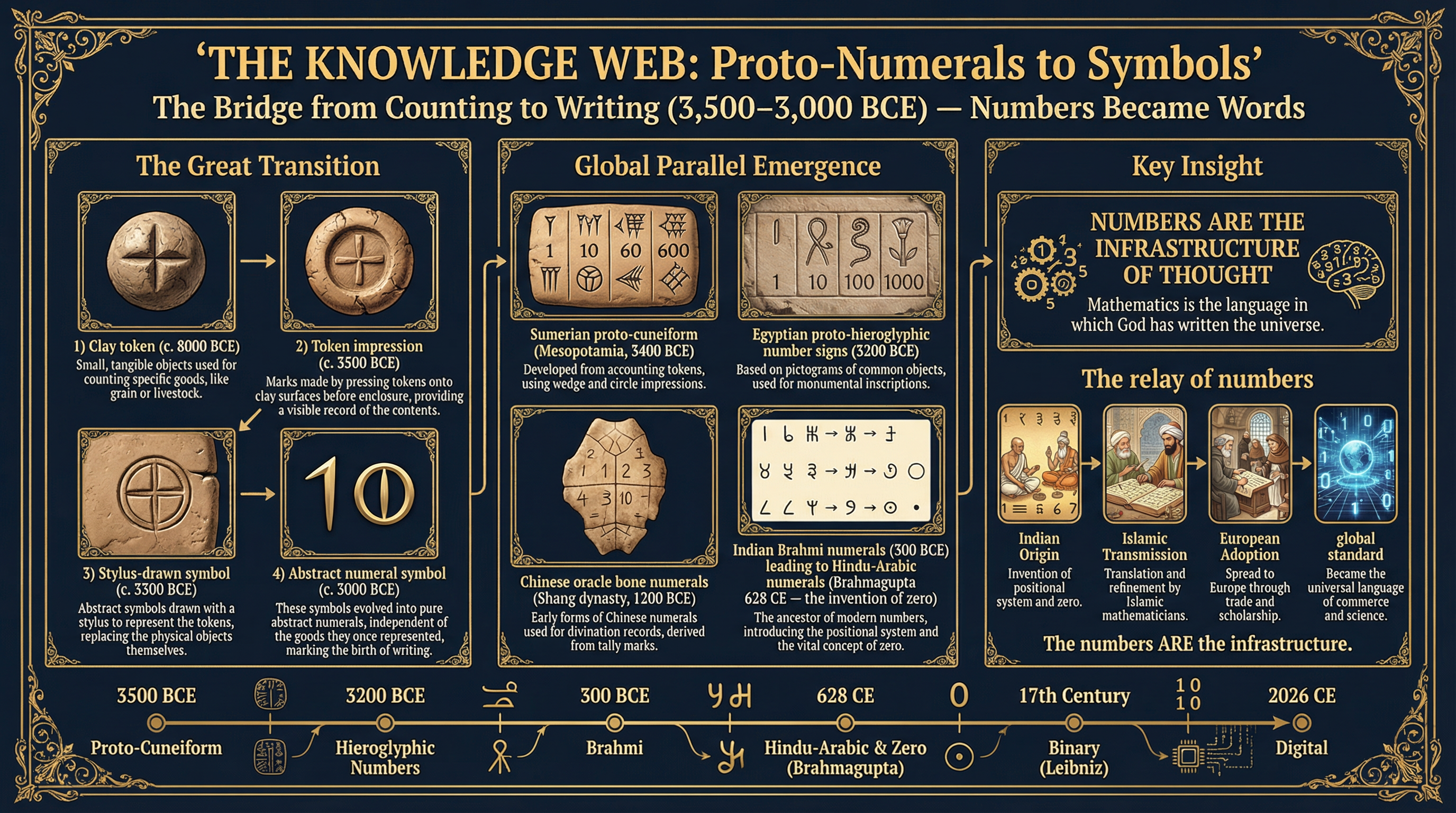
THE KNOWLEDGE WEB: Proto-Numerals to Symbols — The Bridge from Counting to Writing (3,500–3,000 BCE)
THE GREAT TRANSITION
| Stage | Date | Description |
|---|---|---|
| Clay Token | c. 8,000 BCE | Small, tangible objects used for counting specific goods, like grain or livestock. |
| Token Impression | c. 3,500 BCE | Marks made by pressing tokens onto clay surfaces before enclosure, providing a visible record of the contents. |
| Stylus-Drawn Symbol | c. 3,300 BCE | Abstract symbols drawn with a stylus to represent the tokens, replacing the physical objects themselves. |
| Abstract Numeral | c. 3,000 BCE | These symbols evolved into pure abstract numerals, independent of the goods they once represented, marking the birth of writing. |
GLOBAL PARALLEL EMERGENCE
| System | Date | Region | Significance |
|---|---|---|---|
| Sumerian Proto-Cuneiform | c. 3,400 BCE | Mesopotamia | Developed from accounting tokens, using wedge and circle impressions. |
| Egyptian Proto-Hieroglyphic | c. 3,200 BCE | Egypt | Based on pictograms of common objects, used for monumental inscriptions. |
| Chinese Oracle Bone | c. 1,200 BCE | China (Shang Dynasty) | Early forms of Chinese numerals used for divination records, derived from tally marks. |
| Indian Brahmi Numerals | c. 300 BCE | India | The ancestor of modern numbers, leading to Hindu-Arabic numerals and the invention of zero (Brahmagupta, 628 CE). |
Mathematics is the language in which God has written the universe. The number system itself is a relay — from Indian origin through Islamic transmission to European adoption to global standard. The numbers ARE the infrastructure. Every calculation, every structural analysis, every digital system uses Indian-origin numerals and zero. The relay of numbers IS the thesis.
IV. THE NUMBERS CODEX
Every number in the thesis is deliberate — a catalogue of numerical intent
Throughout An Infrastructure Odyssey, numbers are not arbitrary. Each carries deliberate encoding — connecting to the thesis architecture, to cultural significance, to mathematical beauty. This is not numerology for its own sake. It is the documentation of a deliberate encoding system that runs through the entire work.
INDIAN MATHEMATICS — THE VEDIC FOUNDATION
The thesis claims infrastructure is universal — all civilisations built it. Indian civilisation’s mathematical contributions are foundational to ALL modern infrastructure. Every calculation, every structural analysis, every digital system uses Indian-origin numerals and zero. The Numbers Codex honours this heritage.
| Contribution | Source | Date | Impact |
|---|---|---|---|
| Invention of Zero | Brahmagupta | 628 CE | The concept of shunya (void) as a number — the foundation of all modern mathematics and computing. |
| Vedic Mathematics | Sulba Sutras | c. 800 BCE | Ancient mathematical traditions encoded in the Vedas — geometry, algebra, and astronomical calculations. |
| Place-Value Notation | Aryabhata | 476–550 CE | Developed place-value notation, approximated pi, described planetary motion. |
| Hindu-Arabic Numerals | Indian Origin | c. 300 BCE onward | The “Arabic” numerals are actually Indian, transmitted via the Islamic Golden Age to Europe and the world. |
| Intuitive Mathematics | Ramanujan | 1887–1920 | The legendary self-taught mathematician whose intuitive grasp of numbers borders on the mystical. |
V. THE RELAY OF NUMBERS
From Indian origin to global standard — the number system IS a civilisational relay
The transmission of the numeral system across civilisations is itself a perfect demonstration of the thesis. Numbers were invented in India, refined and transmitted through the Islamic Golden Age, adopted by Europe through trade and scholarship, and became the universal language of commerce and science. The relay of numbers IS the thesis in miniature.
Invention of positional system & zero
Translation & refinement by Islamic mathematicians
Spread through trade & scholarship
Universal language of commerce & science
This relay demonstrates every principle of the thesis: knowledge passes between civilisations, each adding value. No single culture owns mathematics. The relay is the mechanism by which human knowledge becomes universal infrastructure. The numbers are not just tools — they are the infrastructure of thought itself.
The number system itself is a relay — from Indian origin through Islamic transmission to European adoption to global standard. Every bridge, every building, every digital system, every financial transaction relies on this relay. The numbers ARE the infrastructure. And the relay of numbers IS the thesis.
VI. THESIS CONNECTION
How “Before Writing” connects to the 12 Civilisational Relays
The “Before Writing” exhibit sits before Relay 1 (Fire) in the thesis chronology. It establishes that the cognitive infrastructure for abstract thought — counting, quantifying, recording — existed for 35,000 years before the first relay. The relays are the visible infrastructure of civilisation. The numbers are the invisible infrastructure that made them possible.
| Connection | Relay | How Numbers Enabled It |
|---|---|---|
| Calories | Relay 1: Fire | Counting days, tracking seasons, measuring food stores — the caloric foundation required quantification. |
| Settlement | Relay 2: Tree | Land measurement, timber counting, resource allocation — permanent settlement required accounting. |
| Exchange | Relay 3: River | Grain accounting, trade records, taxation — river civilisations invented writing FROM accounting. |
| Empire | Relay 4: Horse | Census, military logistics, tribute calculation — empire requires counting at scale. |
| Digital | Relay 10: AAA Triad | Binary (1/0), algorithms, computation — the digital age is built entirely on numbers. |
| Consciousness | Relay 12: Human Nodes | The thesis itself — 575,801 words, 2,645 tasks, 360 blocks — documented through numbers. |
THE FAMILY CONNECTION
The Dearden family embodies the entire arc from pre-literate oral tradition through to modern infrastructure. Helen Lesley Zavacky (née Dearden) — Financial Controller — connects to Relay 3 (River): proto-writing arose from grain accounting, which became cuneiform, which became the foundation of all written civilisation. Accounting → the need to record → proto-writing systems. Sound predates writing. Writing predates engineering. Engineering requires accounting. The family IS the thesis.
PER ARYA AD ASTRA
Through nobility, to the stars
Block 360 • Day 127 • 12 March 2026