
The Nexus Explained
The Water-Power Nexus describes the fundamental interdependence between water systems and energy systems. Desalination plants consume enormous quantities of electricity. Power stations require vast volumes of cooling water. In arid regions like the UAE and the broader Middle East, this interdependence becomes the central planning constraint for all infrastructure development.
The Infrastructure Academy identifies this nexus as one of the most critical convergence points in the UN Sustainable Development Goals framework. SDG 6 (Clean Water & Sanitation) and SDG 7 (Affordable & Clean Energy) cannot be addressed independently — progress on one directly enables or constrains progress on the other.
Water Requires Energy
- Desalination (reverse osmosis, thermal)
- Pumping and distribution networks
- Wastewater treatment and recycling
- Irrigation systems and agriculture
- Industrial process water
Energy Requires Water
- Thermal power plant cooling
- Hydroelectric generation
- Nuclear reactor cooling systems
- Solar panel cleaning (desert regions)
- Hydrogen production (electrolysis)
Case Study: Uticome — UAE Utilities Sector
Uticome (formerly Utico) is a UAE-based independent water and power producer (IWPP) operating across the Gulf region. Founded by Richard Menenzes, the company exemplifies the Water-Power Nexus in practice — simultaneously producing desalinated water and generating electricity from integrated facilities.
The UAE context makes the nexus particularly visible. With minimal natural freshwater resources, the country depends almost entirely on desalination for its potable water supply. This desalination capacity is inextricably linked to power generation, as the energy-intensive reverse osmosis and multi-stage flash distillation processes require reliable, large-scale electricity supply.
Observer Testimony: Richard Menenzes
On 18 March 2026 (Day 133 of the Odyssey), Richard Menenzes reviewed the Infrastructure Academy platform, including the 3 Operational Bridges, the 21-University Assessment Ecosystem, the Ai Organisational Structure (Model B), the Validation Chain, the BitPoints Marketplace (60-card deck), and the iAAi × UN SDG Alignment documentation.
This testimony is significant because it comes from a practitioner who operates at the exact intersection of water and power infrastructure. Menenzes’s observation that the platform’s value lies in “doing Good” aligns with the iAAi framework’s positioning as an educational commons rather than a commercial product — infrastructure knowledge as a public good.
iCard Evidence
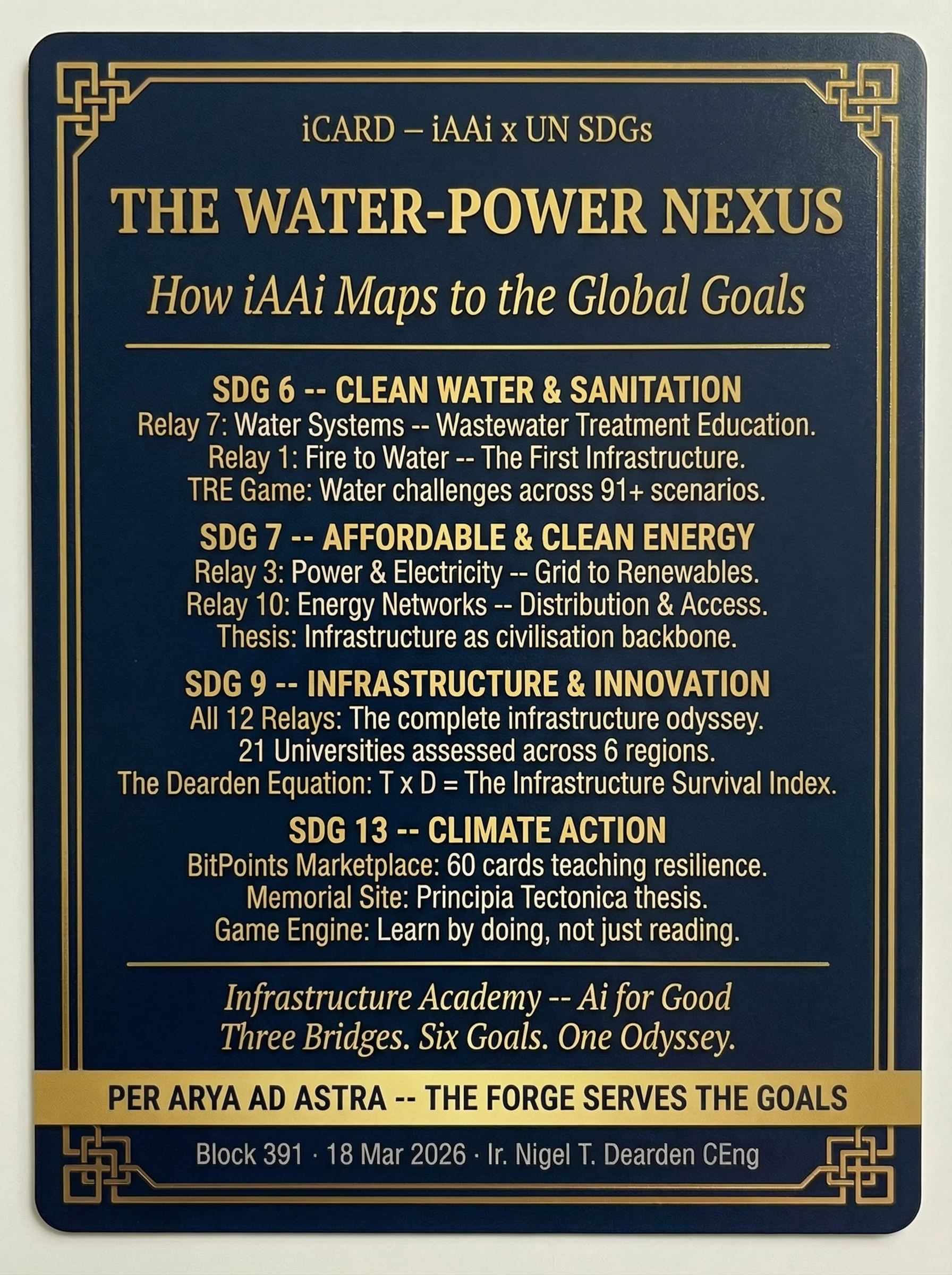
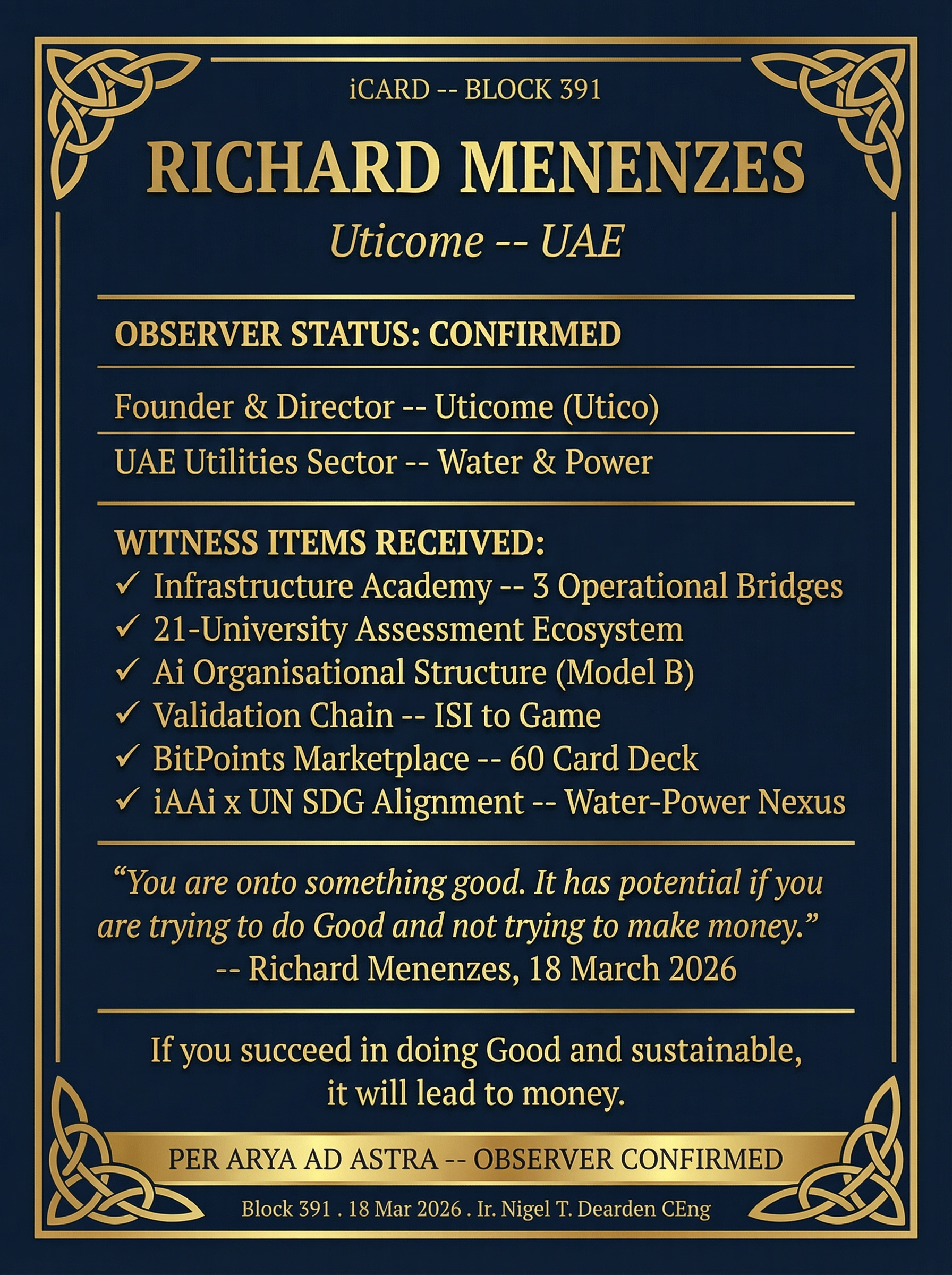
The Food-Energy-Water (FEW) Trilemma
The Water-Power Nexus is itself part of a larger infrastructure trilemma. The Food-Energy-Water (FEW) Nexus is the dominant infrastructure planning framework used by the World Economic Forum, the UN, and national governments worldwide. It recognises that food production, energy generation, and water supply are so deeply intertwined that addressing any one in isolation creates unintended consequences for the other two.
How the Three Systems Interlock
Food → Water
- Irrigation demand (70% of withdrawals)
- Fertiliser runoff & water pollution
- Food processing water use
- Livestock water footprint
Water → Energy
- Desalination energy demand
- Pumping & distribution networks
- Wastewater treatment energy
- Hydroelectric generation
Energy → Food
- Mechanised agriculture fuel
- Fertiliser production (Haber-Bosch)
- Cold chain & food storage
- Biofuel vs food crop competition
The UAE as a FEW Nexus Laboratory
The UAE represents one of the most extreme FEW Nexus environments on Earth. With less than 100mm annual rainfall, virtually no arable land, and temperatures exceeding 50°C, the country must import approximately 90% of its food, desalinate nearly all its freshwater, and generate massive amounts of energy to sustain both systems. This makes the UAE — and companies like Uticome operating within it — a living laboratory for FEW Nexus solutions.
Implications for the iAAi 12-Relay Framework
The FEW Nexus maps directly onto three of the 12 civilisational relays: Relay 2 (Tree) represents agriculture and food systems, Relay 3 (River) represents water infrastructure, and Relay 8 (Engine) represents energy generation. The trilemma demonstrates why the relay framework must be understood as an interconnected system rather than a linear sequence — the relays loop back on each other in practice.
Why This Matters for Infrastructure Education
Traditional engineering education treats water engineering and power engineering as separate disciplines. The Water-Power Nexus demonstrates why this siloed approach fails in practice. Infrastructure professionals working in arid regions, island nations, or rapidly urbanising economies must understand both systems simultaneously.
The Infrastructure Academy’s 12-relay framework addresses this through Relay 3 (River — water systems), Relay 8 (Engine — power generation), and their convergence in modern infrastructure planning. The Uticome case study provides a real-world anchor for this theoretical framework, grounded in the testimony of a confirmed stakeholder observer.
Implications for the iAAi Framework
The Water-Power Nexus validates the iAAi thesis that infrastructure systems cannot be understood in isolation. The 4ECL (Four Essential Competency Layers) framework requires practitioners to see across traditional disciplinary boundaries. Uticome’s integrated water-and-power operations demonstrate this principle at industrial scale.