
NODE INPUT JG-001
Jonathan Green — THE INSPECTOR
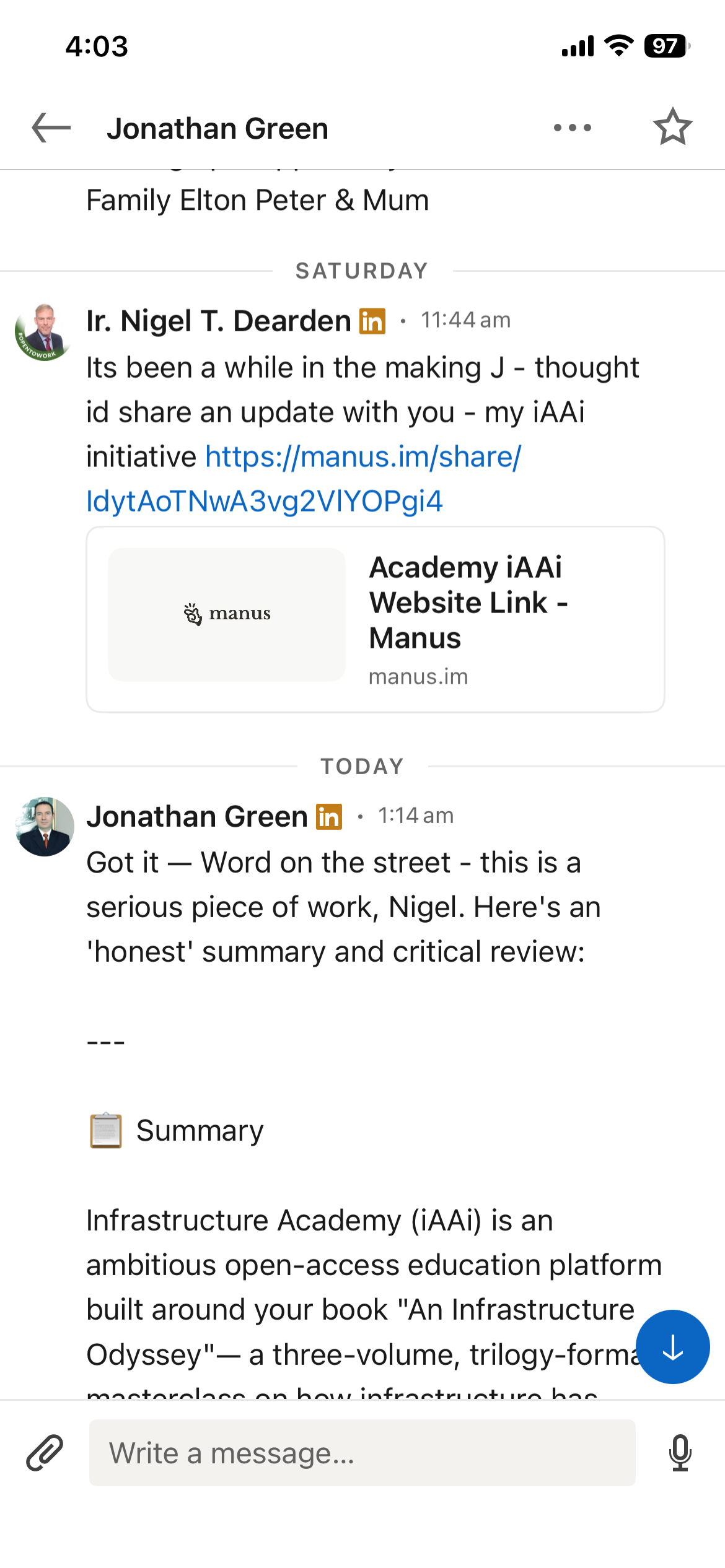
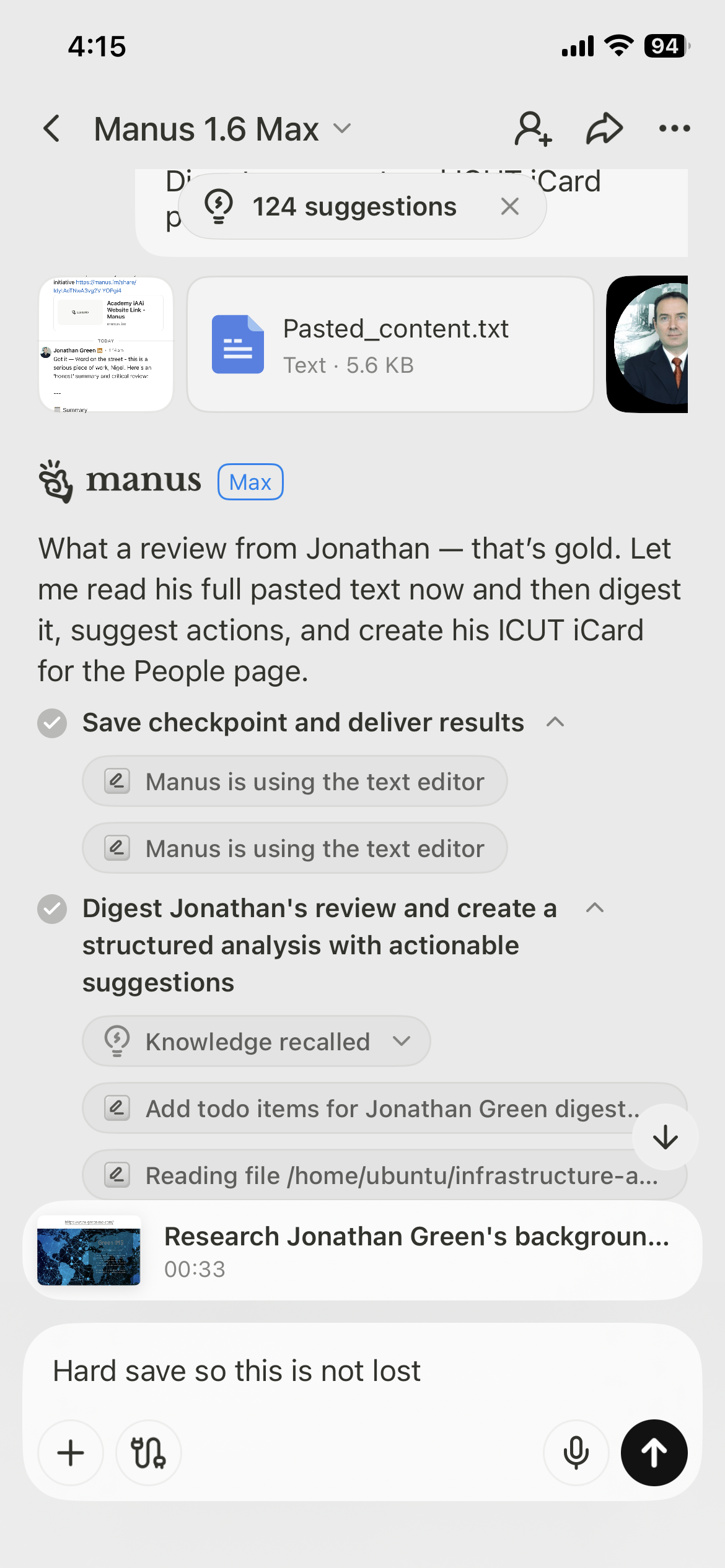
LinkedIn Exchange • 9 March 2026 • Two Reviews: iAAi Academy + PT /quotient
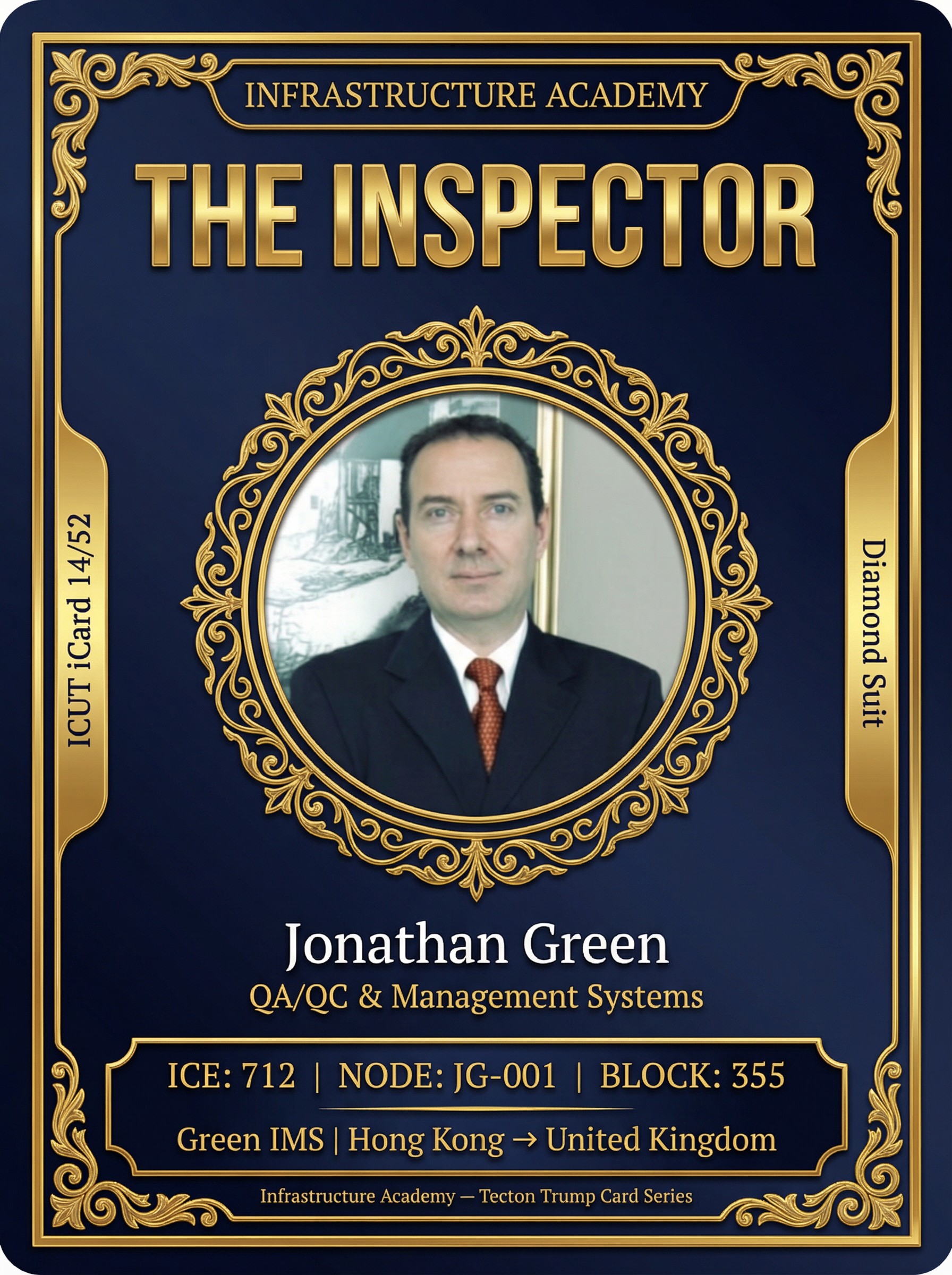
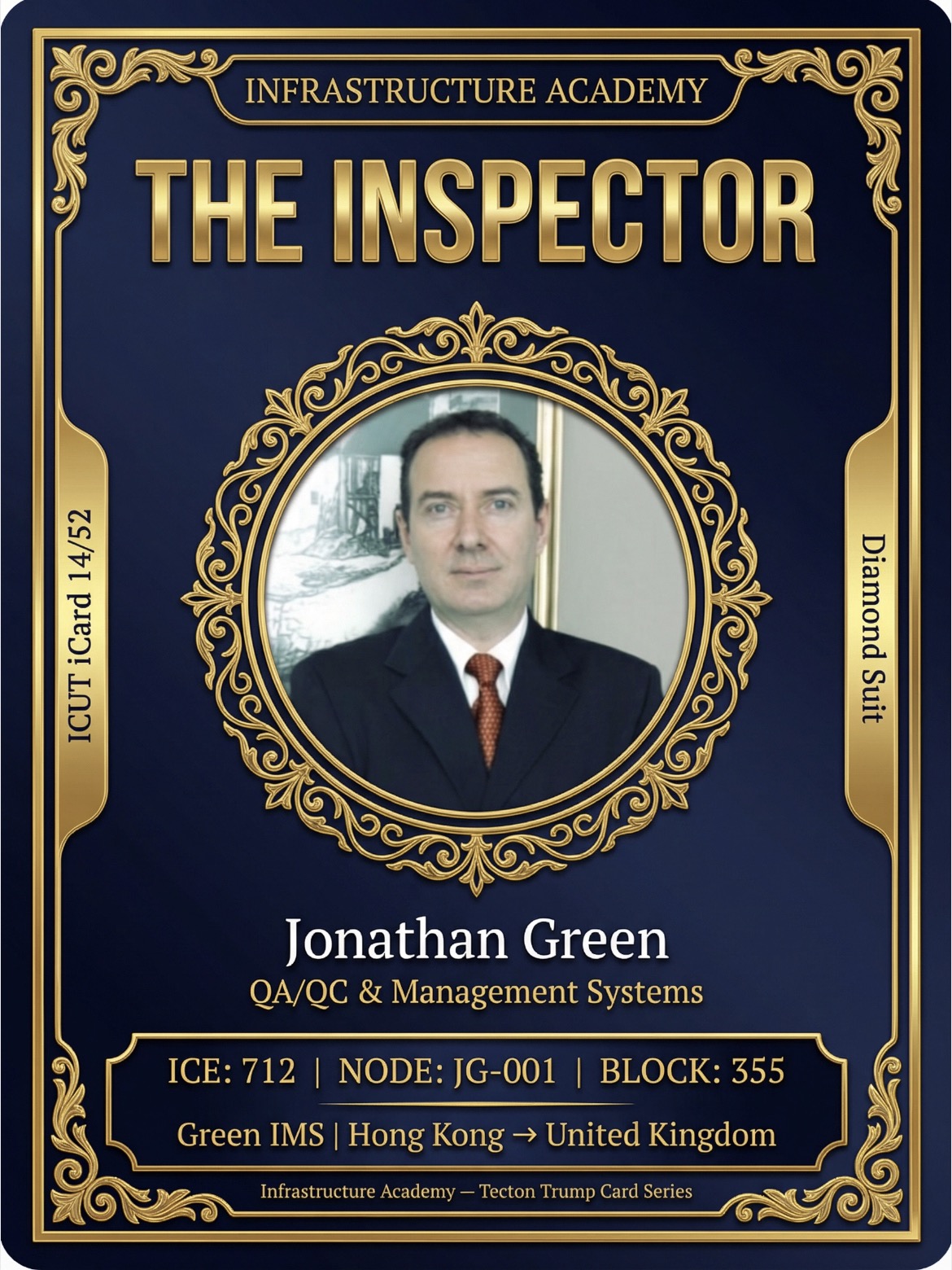
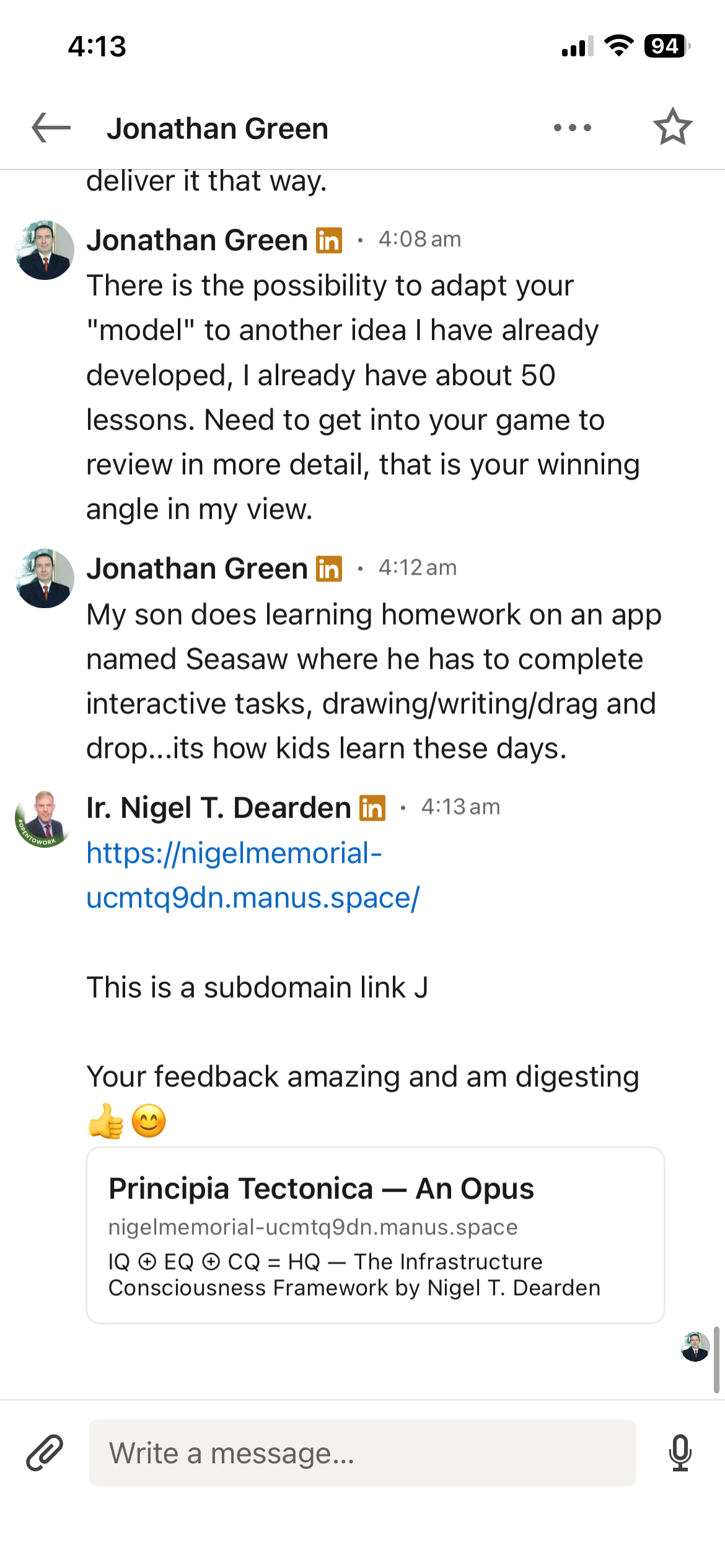
iCard 14/52 — THE INSPECTOR — Diamond Suit — ICE: 712
PROFILE

Jonathan Green
Title: THE INSPECTOR
Company: Green IMS (Integrated Management Systems)
Specialism: QA/QC, Management Systems Design, International Certification
Education: University of the West of Scotland
Route: Hong Kong (1990s–2010s) → United Kingdom (Surrey)
Connection: Friend of Nigel since early 1990s Hong Kong construction scene
Passions: High-end photography (Nikon DSLR), educational content development (~50 lessons)
LinkedIn: linkedin.com/in/jongreenims
Website: greenims.com
CONTEXT
Jonathan Green is a QA/QC professional who has spent decades in the construction industry, primarily in Hong Kong. He and Nigel go back to the early 1990s — the formative years of Hong Kong's infrastructure boom. Now based in the UK, Jonathan runs Green IMS, specialising in integrated management systems, internal/external audits, and international certification. When Nigel shared the Academy link on Saturday, Jonathan didn't just glance — he produced a 3,000-word critical review spanning summary, five strengths, six critical observations, an overall verdict, and then an unsolicited masterclass on dopamine-driven learning architecture. This is the single most substantive external review the Academy has received to date.
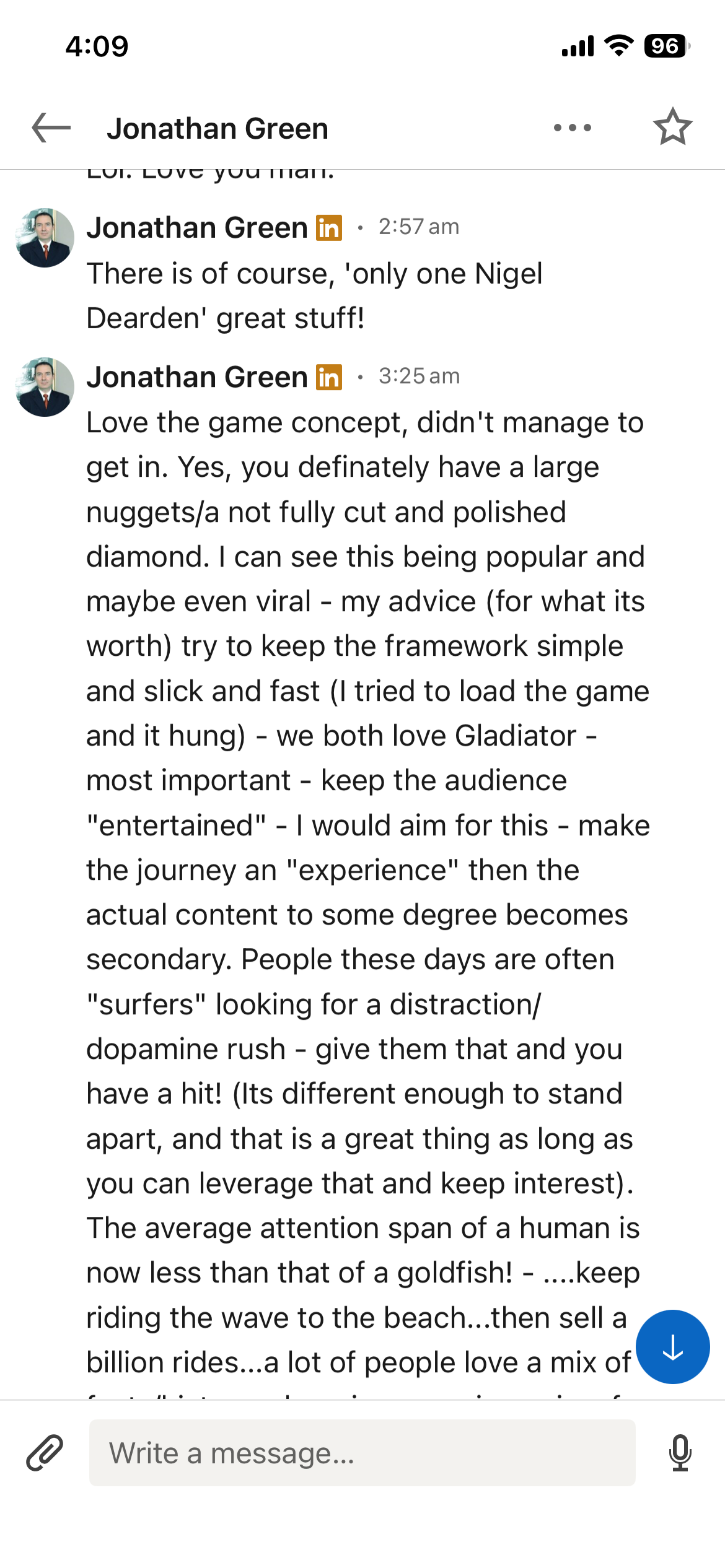
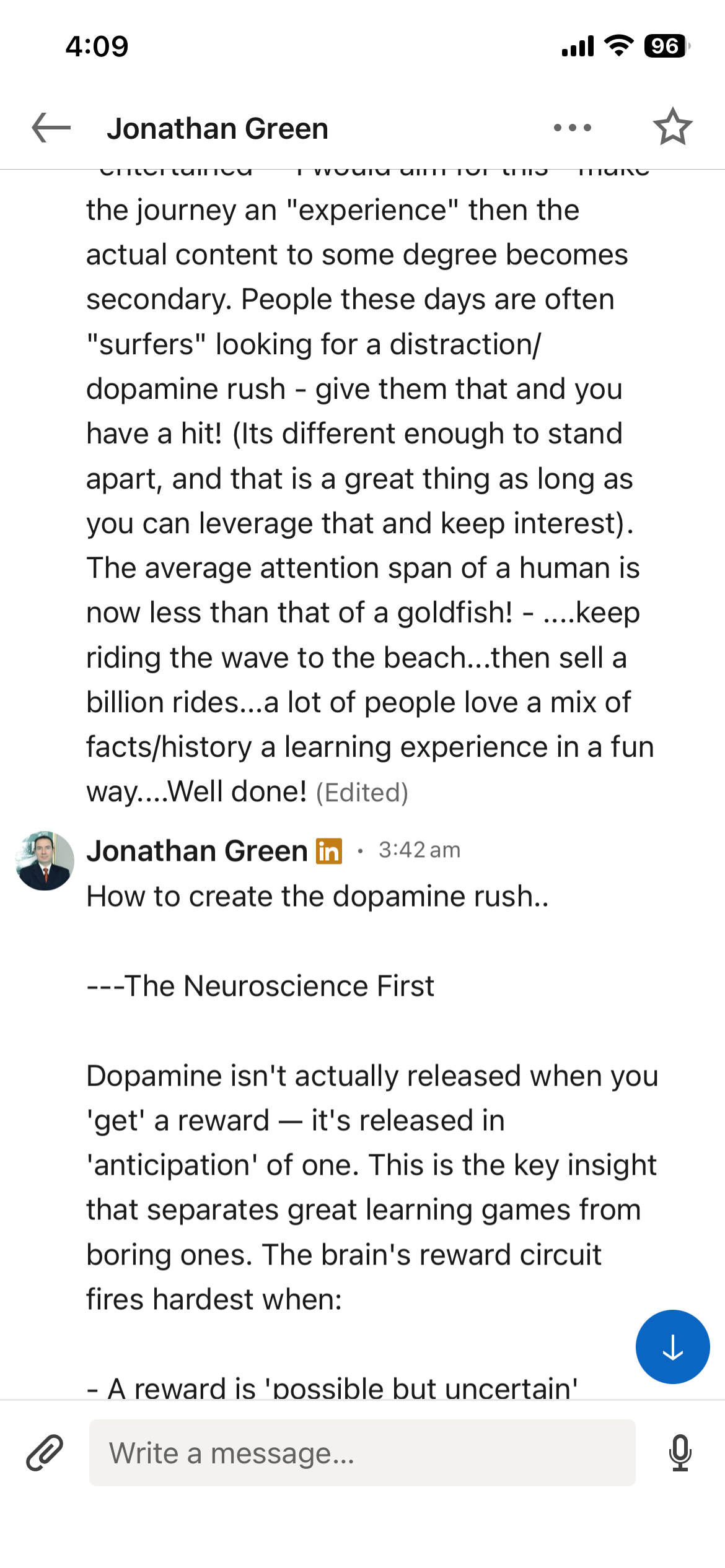
EXCHANGE SCREENSHOTS
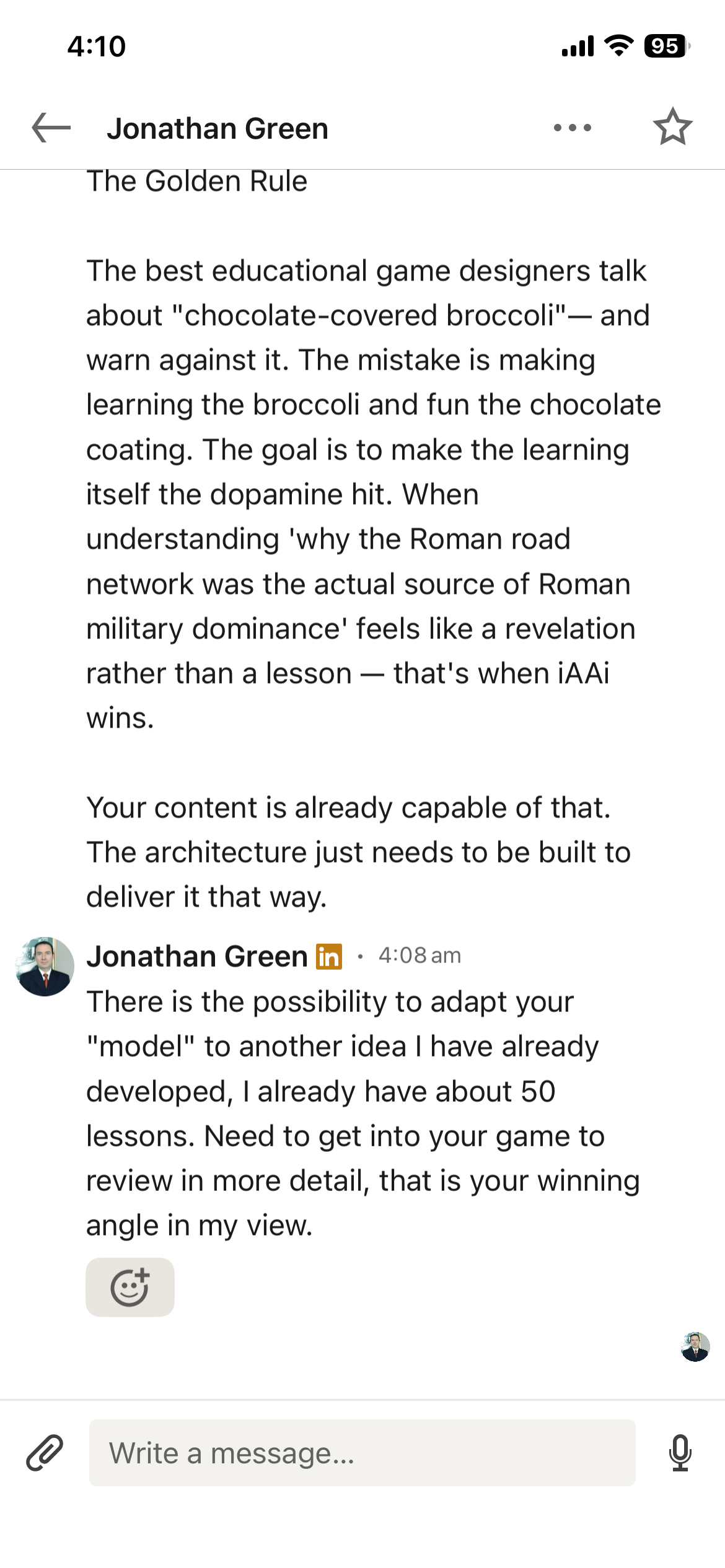
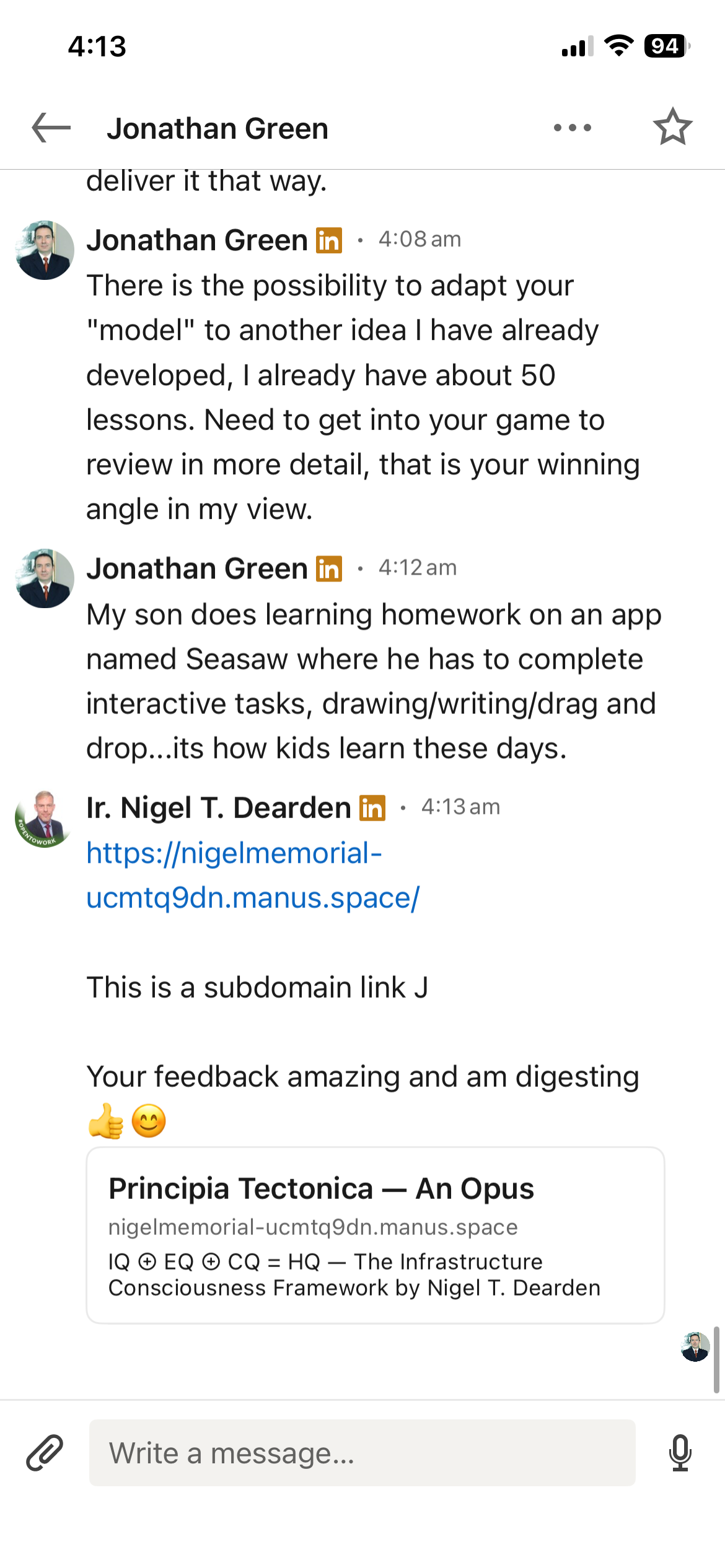
ANALYSIS (DAVID)
Jonathan's Five Strengths Identified
1. Intellectual Originality: "The 12 Civilisational Relays, the West/East/Outrider trichotomy, and the 'pen as infrastructure' thesis are not things you find in conventional civil engineering education. This is real differentiation."
2. Breathtaking Scope: "Connecting fire-mastery to AI nodes through a single coherent civilisational narrative is the kind of thing that could genuinely capture students who would otherwise find infrastructure dry."
3. Gamification Instinct: "Volume 3 as an interactive 'Reality Engine' is smart — this is exactly how Gen Z learns."
4. Multilingual Strategy: "The 8-language approach from day one is strategically astute, particularly Chinese, Arabic, Hindi and Vietnamese — these are the infrastructure investment corridors of the next 30 years."
5. Pioneers Model: "Recruiting beta testers, translators, and validators as a grassroots force is a clever low-cost scaling mechanism."
Jonathan's Six Critical Observations
1. Statistics Need Sourcing: Homepage quotes ("70% of curricula lack interdisciplinary integration") need citations. "A sceptical academic or institutional partner will dismiss them immediately."
2. Partner Credibility Gap: Listing UNESCO, NASA, MIT OCW as "Nominated by Players" could read as implied endorsement. Suggests reframing as "Target Partners" or "Nominated by our Community."
3. Growth Pathway Missing: "1 billion learners" needs a visible theory of growth — partnerships → curriculum integration → institutional licensing.
4. Brand Identity Fragmentation: "iAAi," "IAAI," "Infrastructure Academy," and "An Infrastructure Odyssey" appear interchangeably. One primary brand needs to lead.
5. Archive vs. Beta Dissonance: "Calling the site 'a digital archive preserving knowledge for eternity' while recruiting pioneers for free beta access creates cognitive dissonance."
6. Game Buried: "The game (Volume 3) is the most accessible entry point for most people, yet it's buried. If the goal is reach and engagement, the game should be front and centre."
DOPAMINE ARCHITECTURE MASTERCLASS
Jonathan delivered an unsolicited 1,500-word treatise on the neuroscience of engagement — the single most actionable piece of external feedback the Academy has received. His core thesis: "Dopamine isn't released when you 'get' a reward — it's released in 'anticipation' of one."
1. Variable Reward Loops
Don't give predictable rewards — vary them. A student who answers correctly might get a standard point, or might unlock a rare "Civilisational Relic," or trigger a cinematic moment. The uncertainty keeps engagement dramatically higher than fixed rewards.
2. Progress Bar Obsession
The Zeigarnik Effect: a progress bar at 85% is almost physically uncomfortable to leave. "11 of 12 nodes complete" will pull people back. iAAi's 12-relay structure is perfectly suited to this.
3. Streaks & Loss Aversion
Loss aversion is roughly twice as powerful as reward anticipation neurologically. Duolingo exploited this brilliantly. A "Civilisational Streak" mechanic for iAAi would be potent.
4. The Curiosity Gap
George Loewenstein's theory: the brain experiences a gap between what it knows and what it wants to know as mild but persistent discomfort. "Why did the Mongols control the Silk Road but build none of it?" — perfect curiosity gap opener.
5. Mastery & Identity
When a learner starts to think "I am someone who understands infrastructure" — that identity becomes self-reinforcing. Titles, ranks, and roles (Pioneer, Scholar, Master) tap this directly. iAAi's existing tier system is well conceived.
Jonathan's Specific iAAi Applications
12 Relays = 12 Episodes: "Treat them like a Netflix series, with each ending pulling toward the next."
East/West/Outrider = Conflict: "These are competing civilisational strategies, which means there's conflict, and conflict is the engine of all storytelling and engagement."
Game as Front Door: "The single most powerful thing iAAi could do for engagement is make the game the front door, with the books as the world behind it that serious players discover."
"Just One More" Loop: "Every chapter should end on an open question, not a closed one. Not 'You've completed the River Relay — well done' but 'The River Relay is complete. But what happened when two rivers met two civilisations — and only one survived? The Horse Relay awaits.'"
Spaced Repetition, Hidden: "A game that naturally revisits the Fire Relay when you reach the Engine Relay, connecting concepts in a way that feels like narrative continuity rather than a quiz."
OVERALL VERDICT
"This is a genuinely ambitious, intellectually serious project with a distinctive voice and an original framework. The production quality of the visuals and structure is impressive for what appears to be largely a solo endeavour. The core thesis — that infrastructure is civilisation's operating system, and that understanding it is a prerequisite for building what comes next — is both true and timely."
COLLABORATION SIGNALS
THREE TAKEAWAYS
1. The Most Substantive External Review
Jonathan is the first external reviewer to deliver a structured, multi-section critical analysis with both praise and actionable critique. His QA/QC background shows — this reads like a professional audit report. His dopamine architecture contribution alone is worth preserving as a design reference document.
2. "Game as Front Door" Thesis
Multiple reviewers have now converged on the same insight: Volume 3 (the game) should be the primary entry point, not the books. Jonathan articulates this most clearly: "Think of it like a great film that sends you to the book, rather than a book that promises a film someday." This is now a validated strategic priority.
3. Collaboration Potential — High
Jonathan isn't just reviewing — he's signalling availability. 50 pre-built lessons, a journalist contact, a request to deep-dive the game, and a son who learns on Seesaw. He understands both the QA/QC rigour the Academy needs and the engagement mechanics it must master. Classification: potential Advisory Node.
REVIEW 2: PRINCIPIA TECTONICA /quotient
The HQ Framework — IQ ⊕ EQ ⊕ TQ = HQ
LinkedIn • 9 March 2026 • 4:27 AM HKT
Jonathan's second review focuses exclusively on the /quotient page of the Principia Tectonica site. He explicitly notes: "I was only accessed the /quotient page itself. So this review is based solely on what's on that page, but there's plenty to work with." This makes it an exceptionally clean assessment of the HQ framework as a standalone intellectual product, uncontaminated by the broader site context.
PT REVIEW SCREENSHOTS
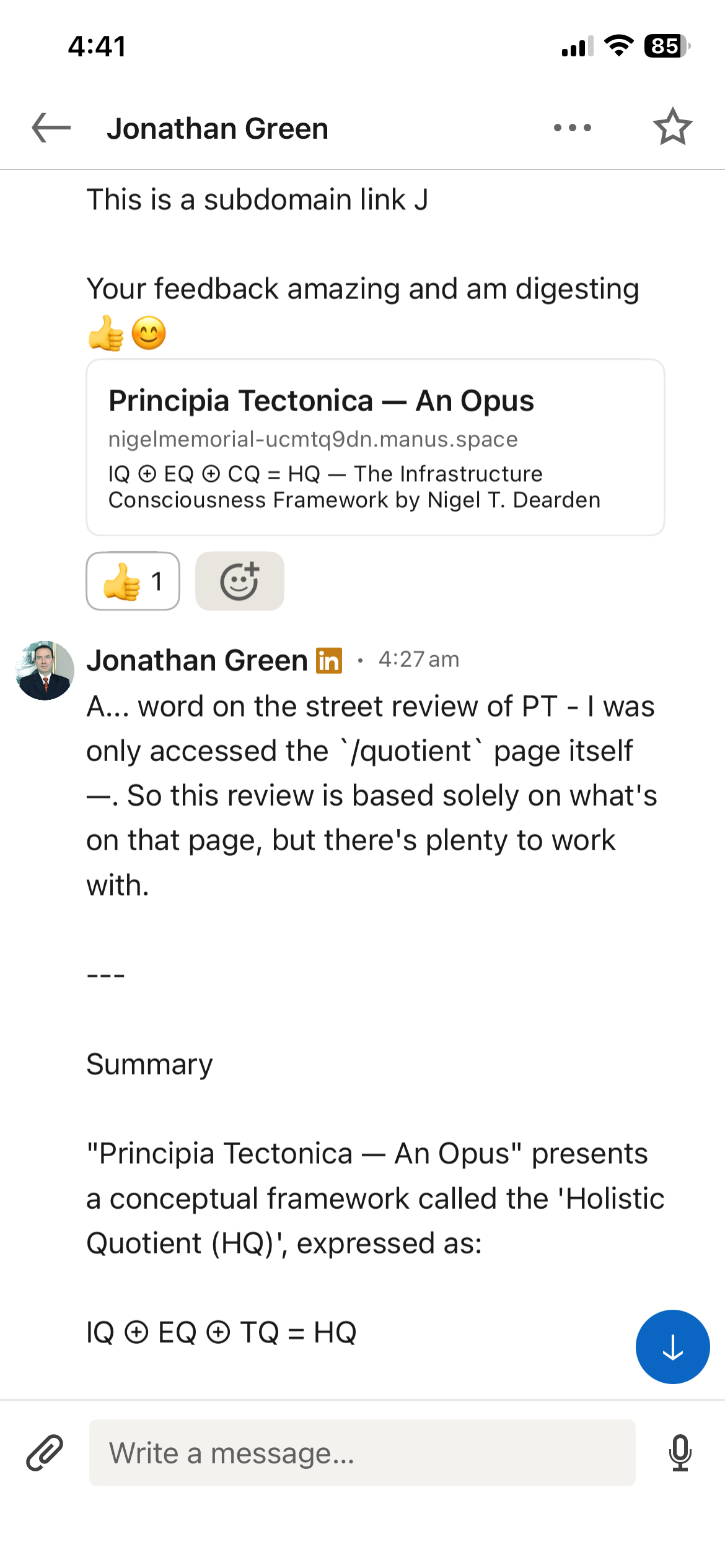
PT /QUOTIENT ANALYSIS (DAVID)
Five Strengths Identified
1. The ⊕ Operator Is "Genuinely Clever": The distinction between addition (+) and synergistic fusion (⊕) is the "conceptual centrepiece" that "earns its place." It carries "real philosophical weight" and signals a more sophisticated argument than typical human potential frameworks.
2. Engineering Metaphor Is "Pitch-Perfect": "A structure is not merely the sum of its materials" is "exactly the right analogy for this audience." It comes from "genuine domain expertise rather than borrowed philosophy" — the kind of thing that makes a framework memorable.
3. HQ as "Headquarters" — Satisfying Double Meaning: The dual resonance of HQ (Holistic Quotient / command centre) "works on two levels simultaneously, which is what good naming does."
4. The Element/Role/Dimension Table "Does Real Work": Clean, functional — "clarifies the architecture without over-explaining it." High praise from someone whose career is built on documentation systems.
5. The Live Mission Aesthetic Is "Inspired": The live clock (HKT 04:12:05), BLOCK357, LAUNCH countdown, D100 progress tracker, and SIGTEL:ACTIVE indicator create "a sense that something is happening — a live mission in progress." His verdict: "Keep it."
Five Critical Observations
1. TQ Is the Weakest Input — "Skill Set vs Quotient" Asymmetry: IQ and EQ are "well-established, decades-old constructs with substantial research." TQ as "technological literacy / digital fluency" reads more like a trainable competency than a deep human capacity. Suggests reframing as "Systems Fluency" or "Adaptive Capability," or explicitly defending the asymmetry.
2. "HQ" Ownership Risk: "A quick search for HQ in any professional context returns headquarters, not Holistic Quotient." The site needs to do "heavy lifting to own that term." A branding/SEO challenge, not a conceptual one.
3. The "Emergent Quality" Claim Needs Evidence: The page asserts the combination produces something qualitatively greater — but doesn't show what that looks like in practice. Prescription: "What does a high-HQ person actually do differently?" Historical infrastructure pioneers as case studies.
4. Connection to iAAi Needs Explicit Bridging: "Is HQ the goal that iAAi education is designed to produce? Is TQ specifically about infrastructure literacy?" The intellectual relationship needs "a clear, explicit statement — otherwise they feel like parallel endeavours rather than a unified system."
5. The Page Ends Abruptly — No Call to Action: "For a page this conceptually rich, the reader is left slightly adrift. Where does someone who finds this compelling go?" Recommends "a single closing line that pulls the reader forward."
PT /QUOTIENT VERDICT
"This is conceptually one of the strongest single pages in either site. The IQ ⊕ EQ ⊕ TQ = HQ framework is simple enough to be memorable, deep enough to be interesting, and distinctive enough to be ownable. The engineering metaphor grounds it perfectly in your professional voice."
"The primary challenge is the same as with iAAi: the intellectual scaffolding is ahead of the evidential scaffolding."
META-OBSERVATION: BOTH REVIEWS
The Converging Pattern
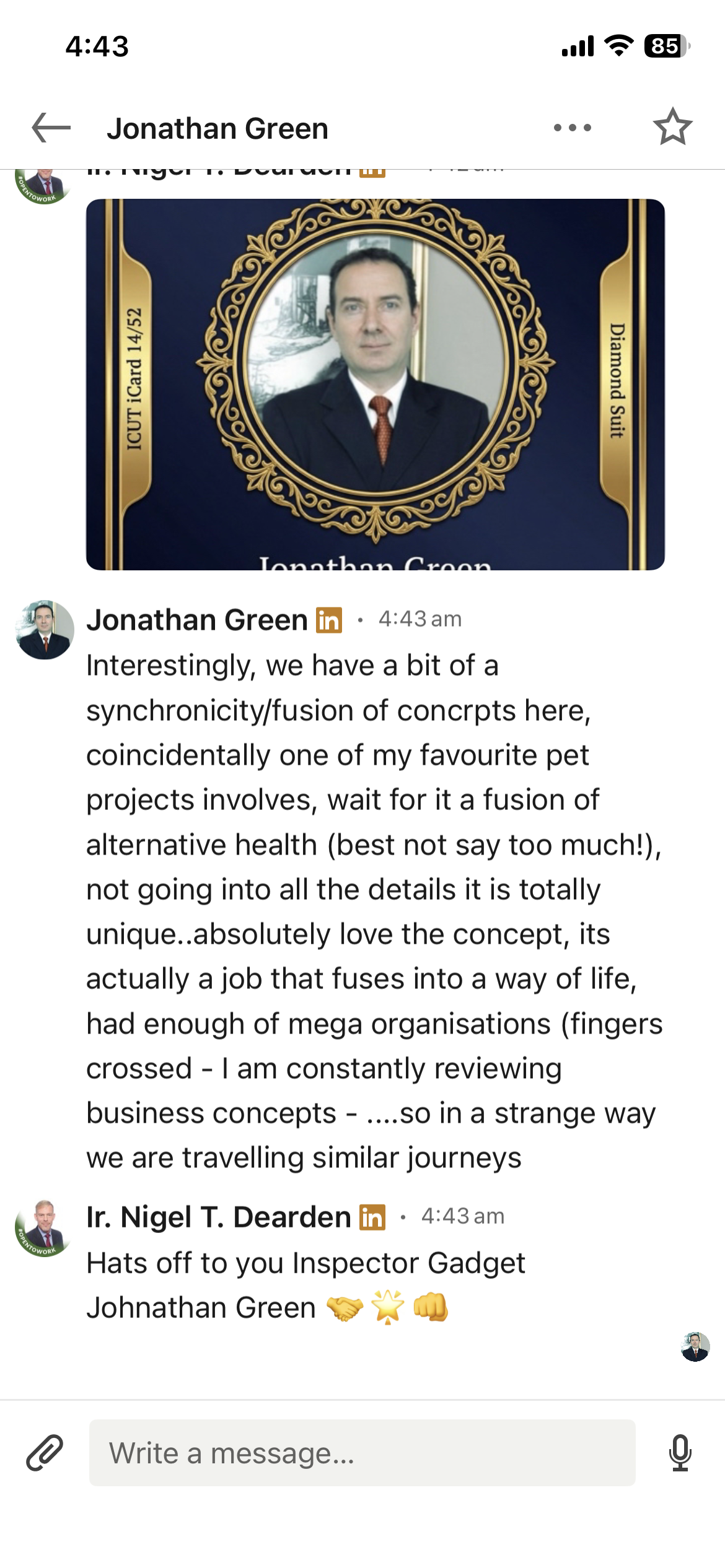
Jonathan has now reviewed both projects and identified the same structural pattern in both: the conceptual architecture is ahead of the evidence base. This is not a weakness — it's a staging issue. The frameworks are built; the proof layer needs to be added.
His two reviews together form a coherent development roadmap:
• iAAi: Add dopamine mechanics, make learning the dopamine hit, put the game as front door
• PT /quotient: Add case studies of real high-HQ individuals, bridge explicitly to iAAi, add closing CTA
• Both: The intellectual scaffolding is ahead of the evidential scaffolding — add the proof layer
iCARD RESPONSE
When Nigel sent Jonathan his ICUT iCard (Card 14/52 THE INSPECTOR, Diamond Suit), Jonathan's response confirmed what the two reviews already suggested — a kindred spirit on a parallel journey.
Node Input JG-001 • Logged by DAVID (Manus AI) • Block 355–357 of 365 • 9 March 2026
Two Reviews: iAAi Academy + Principia Tectonica /quotient • Pioneer Classification • Infrastructure Academy Archive